This is a semi-scientific story of a hydrogen atom. Very early after the formation of our universe (The Big Bang), enormous equal number of protons and electrons, then the only existing particles were moving away from the point of Big Bang explosion with such a velocity that no particle velocity has ever rivalled those speeds. With the creation of the matter and the applied forces both space and time also came to be. Fortunately for us there were ripples between the particles instead of perfect homogeneity. Because of those ripples, some electrons were getting closer and closer to the nearby protons. Those ripples were the blue-print for the universe, then to the present and to the end, whatever the end will be! This is the story of one of those electrons that happened to move towards a near-by proton though with far less speed than their flying velocities. Both our electron and proton knew particle physics and obeyed the natural laws with absolute accuracy. They had heard of the future Heisenberg’s indeterminism theory, but they only smirked and said “That ain’t us”! Our electron ‘E’, (Fig. I) from point ‘E’ gradually entered the effective gravitational zone of proton ‘P’. From this point our electron gained an acceleration towards our proton. The proton also gained an acceleration but 2000 times smaller towards the electron. At this relatively far distance the electromagnetic attraction force was so insignificant that it was practically ignorable. Fig. I, outer elliptic AMNQ ,(solid line) shows the path of a lighter mass moving towards a much heavier mass if they had no electrical charge similar to the movement of a wandering planet nearing a star. We know depending on the relative positions and velocities of two masses, it could be that the path of smaller mass only bends near the heavier mass and scapes the gravitation of the heavier mass or be captured by the gravitation and collides with the larger mass or like solar planets be set on an orbit around the sun. The orbit can be an elongated to a near round ellipse and in a very rare case a circular orbit depending on the position, speed and the direction of the planet on point ‘M’, (Fig.I, solid line ellipse, AMNQ). The planet speed (amount of velocity) reaches its maximum at point ’N’ and it slows down to its minimum at point ‘A’. For our electron however, the path was different because of the electromagnetic applied forces, (Fig.I, inner elliptic spiral).
- As the electron, (Fig.I) moved towards point ‘M’, it gained physical acceleration (it speed increased) and as a result started to emit radiation i.e. loosing some energy. Therefore the increase of its speed was less than the effect of the total applied forces if there was no radiation emission. It was like if the gas pedal of a car is being gradually pushed down while at the same time parking break is applied. The car would be speeding but not as much as if parking break was not applied.
- At point ’N1’ our electron reached it maximum speed. At this point the total applied forces are perpendicular to the direction of both movement and velocity, changing only the direction of our electron velocity i.e a geometrical acceleration only. The physical acceleration i.e. increase to the electron speed at ‘N1’ was zero. In other words, at point ’N1’ the movement of our electron in the direction of the applied forces was zero and that means zero work and zero expense of energy, resulting in no emission of radiation.
- From point ’N1’ to ‘M1’ as the result of total applied forces our electron had a deceleration. Because this deceleration included a physical deceleration, the electron emitted radiation and lost some energy, which means further reduction of speed. Bringing the above car analogy, the deceleration between ’N1’ and ‘M1’ was like while the break pedal is being pushed down the parking break is also applied that causes further reduction of speed.
- Beyond point ‘M1’ although only the gravitational force is effectively applicable, still because of deceleration, there was some emission of radiation i.e. expense of energy and increase to deceleration.
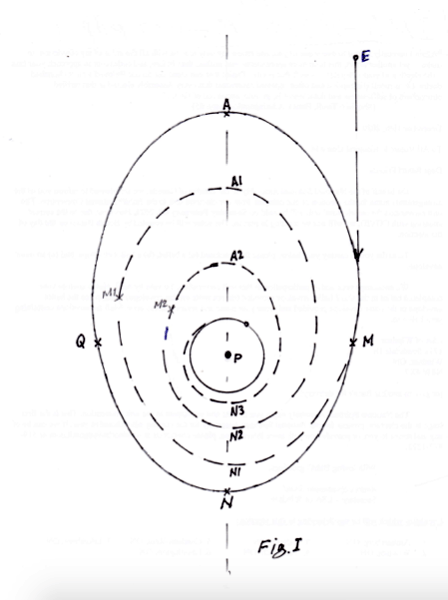
The result of the above 4 effects was; On the right side of the path of the electron the radiation emission caused our electron to reach to a lower maximum speed than otherwise, at point ’N1’. On the left side of its path its speed was further reduced, that means the highest point of the electron path was lower than point ‘A’. On its second path with its lower speed on its right side movement, our electron turned to the left earlier than otherwise on its way to point ‘N2’. At point ‘N2’ the electron was closer to ‘P’ i.e. the orbit became less elongated. This process continued on a spiral path, each path became more round than the previous path until the orbit became a perfect circle. With a circular orbit there was only geometrical and no more any physical acceleration, thus no more radiation. With no radiation (loss of energy), the orbit became stable.
Until the beginning of the twentieth century an atom was regarded as a nucleus with some electrons stuck to it. Early in the twentieth century Ernest Rutherford suggested the structure of atoms as analogous to our solar system with electrons like planets orbiting their nucleus. Since planets orbits around the sun are elliptical, it was taken for granted that electrons orbit must also be elliptical?
Our electron path could have been with more or less spirals on Fig.I. I just wanted to give our electron and proton a three spiral dance. The hydrogen couple dance was and remained hand to hand, i.e. they dance with two arm-length distance between them, an exact length. The German scientist Max Plunk discovered that there is a minimum energy amount, He called ‘Quanta’. In case of our hydrogen couple it is a smallest force rather than energy that causes their exact distance, since human was not evolved yet to invent a mathematical relation that he called energy but force existed as a natural entity. After their spiral dance they finally married as a couple. Since at that time, there was no one except God, maybe God Himself read the marriage vow! Our electron and proton then became a hydrogen couple. I like to say they did not get into any chemical reaction to separate even temporarily and escaped from going to the centre of any star to be fused to heavier elements. They married 13 billions years ago and lived happily ever after, O, those radiations that the electron bride was giving away were indeed the sparkles that the bride was making with a sparkler in her hand at her wedding. Those sparkles had a specific colour that belongs only to hydrogen atoms. The echoes of those sparkles that are still coming to us from all directions were the most important observation that lead the scientists to come with the “Big Bang Theory”. Very early after their marriage they became best friends with another hydrogen couple and became a hydrogen molecule as we call them, though they do not recognize “molecule” as their title and call themselves only as best friends. They dance a continuous “merry-go-round” dance with their best friends unless when they are at the zero degree absolute temperature, then it’s too cold to dance. I believe they are chaste couples and do not exchange electrons! Their bond of marriage is quite strong, whenever they are shaken hard with life difficulties, instead of separating they sparkle radiation photons as if they are saying: “Our love and attraction is unbreakable”.
If you are interested in the mathematical relations of the structure of the hydrogen atom, you can study Neal Bohr’s work on this subject. In his calculations Bohr considers the electron orbit to be elliptical as it was suggested by Rutherford. In order to solve the problem that why the electrons are not emitting continuous radiation in their orbit despite the well stablished J.C. Maxwell’s electromagnetic law, loosing energy and collapsing, Bohr postulated that there is an exception in this case that the electrons do not emit radiation on their orbit around the proton. The problem is that If the orbit be elliptical, the electron MUST go through physical accelerations and decelerations i.e. increase and decrease of the magnitude of its velocity on each orbit, emitting radiation and as a result loosing energy and be unstable.
Recommended reading:
 uni2cy