Contents
Introduction
How Divinity is Defined
A Well-Ordered Universe
Determinism vs Indeterminism
The Evolution of Species
The Reality of Divinity
The Purpose of Life
The History of the Revelation of Baha’u’llah
Teachings of Baha’u’llah
Conclusion
References
Introduction
Religious beliefs directly and indirectly influence our personal and social behaviours. Even those who are not religious, by their society standards are under influence of religions. Therefore if Divinity is not a reality, our decisions and actions are made on an erroneous base. Numerous restriction are observed on the basis on a wrong notion and times spent in religious pursuits is only a waste of time. On the other hand, if God does exist to be unaware of His existence would be a profound ignorance. An individual’s whole life in that sense would be idle and a complete loss if knowing and loving the creator and gaining spiritual progress during life, as religion claims are the very reason we exist. However, in spite of its importance the truth is not difficult to find. This search is the subject that will be discussed in this book. For objective and useful search, the seeker should free herself/ himself from any prejudice for or against the subject under the investigation. Otherwise, one might accept or reject an argument based on what he/she may like to believe rather than based on facts. The seeker should study, investigate and ponder without being bound by preconceptions.
This book is divided into two parts. The first part is concerning man’s understanding of God and the reality of Divinity. Some general knowledge of sciences will make the first part easier to understand. However, only simple scientific references are used in order to make it also useful for those who are less familiar with the scientific theories.
The second part of the book is an introduction to the Baha’i Faith and the reasons to accept it as the truth. The reader has been asked to be objective and fair-minded in his study. This is also how the book was written. In introducing the revelation of Baha’u’llah, history books are excerpted or directly quoted for accuracy and the teachings of Baha’u’llah are for the same reason introduced by quotations from the original Baha’i writings.
I acknowledge my appreciation for the generous assistance of those who helped me in this work, in particular: Terrence Robinson, Mitra Pezeshk Zad – Mozoon and Michaela Baer.
How Divinity is Defined
Before elaborating on the main topic, demonstrating the proofs for the existence of God let us briefly examine how different religions have presented the Divinity throughout the ages. In ancient beliefs, God has been symbolized by various tangible objects such as trees, idols or animals. In Judaism it is said that God created man in His Own image, in Mithraism and Zoroastrian religions sun is the symbol of God, in Christianity God is described as the heavenly Father, in Islam it is said that God is the light of heavens and earth and in the Bah’i Faith, God is the “Inconceivable Supreme Being”. This succession of expression is explained by one the teachings of Baha’u’llah known as the ‘Progressive revelations’. It is explained that the successive religions were revealed to guide mankind throughout the ages and as the needs and understanding of mankind changed and improved, new teachings and new expressions were given. It is also explained by this particular teaching that the prophets have always taught the people with regard to the capacity of understanding of their particular society and era, but not according to the prophet’s own Devine knowledge. This can be compared to the school teachers who progressively in each grade teach subjects at a level understandable to the pupils. Baha’u’llah states:
“To every discerning and illumined heart it is evident that God, the unknowable Essence, the Divine Being, is immensely exalted beyond every human attribute, such as corporeal existence, ascend and descend, egress and regress. … He is and hath ever been veiled in the ancient eternity of His Essence…”1
and also:
“The conception of the devoutest of mystics the attainment of the most accomplished.. are all the products of man’s finite mind and are conditioned by its limitations…”
Any imagination regarding God is the creation of our mind and not the creator of the Universe. However, we are able to understand the truth of the existence of God.
Our understanding and imagination are limited to a three dimensional world. Anything beyond this can only be comprehended through their effects. In order to demonstrate how we are unable to imagine, for example a four dimensional world let us see how an imaginary two dimensional intelligent creature (that we are able to imagine), is unable to conceive our three dimensional world. Imagine ‘beings’ that have only length and width but no depth, like the letters ‘p’ and ‘q’ on the surface of the paper without any thickness and an intelligent dot (.) also having length and width on paper but no thickness. Our intelligent dot can move across and along the paper but is unable to move up or down nor can it understand the concept of thickness or the third dimension of up and down! Our imaginary intelligent dot is well familiar with both ‘p’ and ‘q’ as they exist in his two dimensional world but he is absolutely unable to imagine a three dimensional world where things like ‘p’ and ‘q’ can have thicknesses and be identical things. It is beyond his mind that in a three dimensional world the ‘p’ could be flipped over in the third dimension and be put down as ‘q’. His understanding of a man could only be through something like man’s shadow in his world. Similarly, we cannot imagine a fourth dimension, for example imagining time as an independent dimension. The above example was given to demonstrate how our mind is limited in a three dimensional world. The intention is not to suggest that God is dimensionally inconceivable.
Other examples which also indicate limitations of our understanding and knowledge can be noticed in sciences. Scientists have discovered the gravitational and electromagnetic fields of force. We can observe the effects of the natural forces, have devised methods and mathematical formulas to measure their effects but the nature of ‘how’ and ‘why’ of the fields of force are mysteries. We have quantitative knowledge but not qualitative understanding of them. To explain a phenomenon in physics for example, means that it can be shown that the phenomenon takes place according to a certain law of nature. ‘To understand a natural law’ is only possible so far as that law can be referred back to a more general law of nature. For example, the phenomenon of formation of rain from clouds can be said that is explained by the laws of thermodynamics that under certain conditions of pressure and temperature vapour condenses to liquid or that Kepler’s laws of planetary motions are understood by the more general laws of Newton’s gravity and the second principle of dynamics. There does not exist any other kind of understanding in physics. In referring back to more general laws, there is an end to this process and when it reached, the natural laws cannot be explained.
Abdu’l-Baha 2 in ‘Some Answered Questions’ compiled in 1906, in some of His speeches addressed during His tour in North America in 1912 and in a letter in response to the Swiss scientist Professor August Forel’s questions in 1921, known as the ‘Tablet to Dr. Forel’ has given indisputable and scientific proofs for the existence of God. His reasoning is brief and consequently condensed. The next three sections are statements of the facts that are required to study that unique reasoning. The subjects discussed in sections two, three and four are not proofs for the reality of Divinity, but only some facts.
There is a common adage that ‘God cannot be proven’ as part of another common perception that ‘science and religion do not mix’ but it should not be surprising that Baha’is use scientific method to study the reality of Divinity. Baha’is believe, as one of the teachings of the Baha’i Faith that since both religion and science are realities, they must be in harmony. Professor William S. Hatcher in ‘Logic and Logos’ explains use of scientific method in the Baha’i Faith studies.
“Science is self-conscious common sense. Instead of relying on chance happenings or occasional experiences, one systematically invokes certain types of experiences. This is experimentation (the conscious use of experience). Instead of relying on naive reasoning one formalizes hypotheses explicitly and formalize the reasoning from hypothesis to conclusion. This is mathematics and logic (the conscious use of reason). Instead of relying on occasional flashes of insight, one systematically meditate on problems. This is reflection, (the conscious use of intuition).
The practice of this method is not linked to the study of any particular phenomenon. It can be applied to the study of unseen forces and mysterious phenomena as well as to everyday occurrences. Failure to appreciate the universality of scientific method has led some to feel that science is only the study of material phenomena. This narrow philosophical outlook plus the historical fact that physics was the first science to develop a high degree of mathematical objectivity, has led to a common misconception that scientific knowledge is inherently limited to physical reality.” 3
A Well-Ordered Universe
“This nature is subject to an
absolute organization, to determined
laws, to a complete order and a
finished design.”4
– Abdu’l-Baha
Everything in nature is a manifestation of four interdependent entities: matter, space, fields of force and time. In the other words; natural formations, events and all other processes are only certain ingredients of matters and their movements or positions in space. Following examples illustrate the above statement.
Various atoms are formed each by a specific arrangement of the same subatomic particles; electrons, protons & neutrons. The difference between gold and lead for instance, is only the number of identical subatomic particles that are combined to form either lead or gold. Electricity is the movement of free electrons. Heat is the vibrational, rotational or transitional movements of molecules or atoms of a substance. Chemical reactions are only displacement of electrons between atoms that forms all chemical compositions including the organic materials of living species. Phenomena on larger scales are also cases of movement of matters; such as the evaporation of water, formation of clouds, wind, day and night and seasons. Any phenomenon analyzed as far as the science allows will be the cases of force, matter and its movement. This fact determines that the natural laws which govern the forces and the movement of matter control the nature and all the natural phenomena. Newton’s mechanics principles, in particular the second principal of dynamics that is also called ‘The Fundamental Principle’ is adequate for the phenomena on the scales that take place on earth and even the scales of the solar system. These laws of physics (natural laws) are strictly invariable and deterministic. The conservation laws of; momentum, forces, matter and energy that are results of these laws make all phenomena strictly deterministic. Fields of force are the strict properties of matter, inseparable from it. One of these fields of force is gravity. Therefore, all natural phenomena from subatomic particles to galaxies movements ought to be well ordered by the causality principle.
The following observations indicate that the natural principles which apply here on earth are also applicable elsewhere in the universe.
- In the solar system, Newton’s law of gravitation and the second principle of dynamics explain the orbital movement of planets and their moons.
- The rotation of double and other multiple stars around common axes confirm general gravity and the second law of dynamics.
- In 1927 Jan H. Oort deduced that the stars in the Milky Way were rotation around a centre through careful observation and analysis of approaching and receding stars. This was before the structure of our galaxy was known. Later, his observation of the rotation of our galaxy was confirmed by other astronomical means, and its rotational speed measured. The shape of all visible galaxies in the universe indicates that they are rotating around their centres. This in turn confirms both Newton’s general law of gravity and the second principle of dynamics.
A few very convincing observations pointed out to a theory that the universe began with what it is called the “Big Bang”. Astronomical observations also indicates that the universe will either expand to absolute zero temperature, or will end collapsing together in a “Big Crunch”.
Determinism vs Indeterminism
“God does not play dice.”
– Albert Einstein
Determinism holds that every event must be caused by some preceding causes, whereas indeterminism accept that event may happen by chance.
Part A – The Pretentiousness of Chance
The theory of probability, an applied branch of mathematics is an approximate method to foresee the outcome of an event when we do not have sufficient knowledge to determine the end result. This method of estimation becomes more accurate when the task is to estimate the combined result of numerous similar events. Using probability is unnecessary when it is possible to calculate and forecast what exactly will happen. The following examples demonstrate the above statement.
Consider a die loaded as bullet in a spring gun and is preset to shoot the die automatically in a definite direction and moment and the following questions are to be answered.
- Will the die continue moving upward with a constant speed?
- Will the die eventually fall to the ground?
- Will the die hit the ground within a marked area (target)?
- Will the number ‘5’ (5 dots) come up?
A group of scientists with all necessary literatures, instruments, data, computer, etc. are going to answer the above questions.
- The answer to the first question is obvious. Gravitational force will reduce die speed upward therefore, the answer is ‘No’, because the gravitational force is an inherent quality of the die and the phenomenon is compulsory.
- The answer to the second question is also easy as the initial speed of the die could simply be calculated and found to be much less than the required velocity to put the die into an orbit around the earth. Therefore, the answer to the second question is ‘Yes”. We have an accurate answer and an approximate answer, using the theory of probability is not required.
- Answering the third question is more difficult. Our scientists will have to calculate the initial direction and speed of the die and consider various factors such as gravity, air friction, wind, shape of the die, etc. in order to be able to predict a patch of land (the square on Fig. 1) within which the die will fall. If our scientists elaborate more on their calculations and use more information and tests, they will be able to predict a smaller patch of land where the die could fall. Now in order to answer the third question the scientists compare the target area, (the circle on Fig.1) with their predicted square patch of land. If their calculated patch is within the target area the answer would be ‘Yes’. The phenomena is certain and the event is not considered accidental. If their predicted patch is totally outside the target area then the answer would be ‘No’. The event is not going to occur and again the case is not accidental and there is no need to use the theory of probability. If a part of the predicted patch is within the target area but the rest of it is outside the target circle, the scientists cannot give a clear ‘Yes’ or ‘No’ answer to the question. They have two choices. One is to go back and perform more accurate calculations to arrive at a smaller predicted patch for an accurate answer of ‘Yes’ or ‘No’, the second choice is to give an approximate answer with the help of the theory of probability. That is dividing the amount of the common area between target and predicted areas,(shaded area, Fig. 1) by the total predicted patch area that will result to a figure between zero and one. This figure is called the probability of the occurrence of the event. For example, the probability of the die falling on the target is 2/3, or there is 67% chance that the die will fall on the target area. In this case the phenomenon is called ‘accidental’. In reality there is no chance involved, rather our knowledge is insufficient to calculate the exact point of fall for an accurate answer. The other choice that the scientists had was to do more accurate calculations to arrive at a more accurate result, i.e. smaller patch where the die will fall and give an accurate yes or on answer. In both cases; a) using the theory of probability to find an approximate answer, or b) doing accurate calculation to determine a definite answer, the nature of the phenomenon of course remain the same but in one case it appears to be accidental and in the other case a predictable result of series of causes and effects. Indeed there is no difference between the two cases other than our knowledge.
- An accurate answer of ‘Yes’ or ‘No’ to the fourth question is extremely difficult, while very simple if the inquirer is satisfied with an approximate answer. In cases like this to determine the probability magnitude simply the number of desired cases is divided by the number of possible cases. The probability of the event is then 1/6 or 17% chance that the die will land with the side of five dots up. This figure of 1/6 is only a human notion and has nothing to do with the real nature of the event.
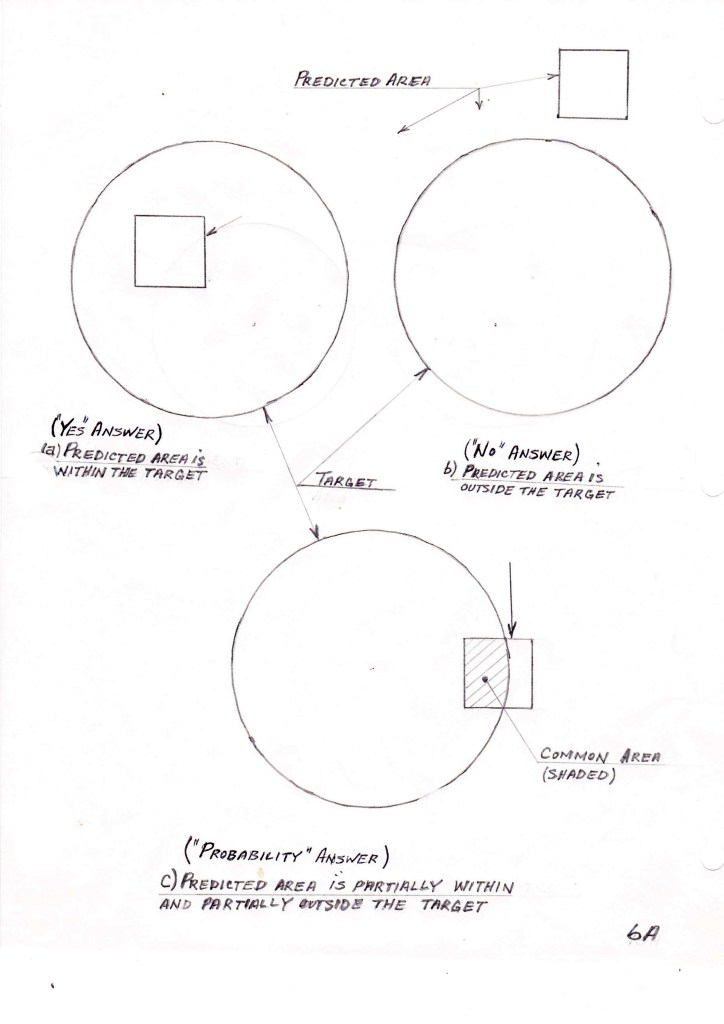
Now assume that the die is shot, we check the answers. Regarding questions; 1 and 2, the die falls to the ground; therefore, ‘No’ answer to the first question and ‘Yes’ to the second were correct. In reality because of natural law of gravity the event has been a necessary or compulsory phenomenon. We do not call it chance or accidental nor ‘random’ simply because it was possible to predicted the result. With regard to the question number 3, the prediction was a 67% chance of occurrence. In fact taking into consideration all initial conditions, the die could only hit the ground where it did, (inside the target), therefore the correct answer to the third question was only ‘Yes’ and saying that the probability was 2/3 was totally irrelevant to the phenomenon itself but only relevant to our knowledge.
The answer to the fourth question will demonstrate to an even greater degree the pretentiousness of chance. Let us assume that the side with two dots came up and not five as it was desired. Again all preconditions such as the direction of the gun, spring compression, air temperature, wind and all other effective factors (causes) were such that the die ought to land with ‘2’ up only. If the test could be performed repeatedly with exactly identical conditions the result would be the same as causes & effects remained the same. In practice this does not happen obviously, since conditions change from test to test. There would be an equal number of favourable cases for all six sides of the dice, as a result if test be repeated the result has the tendency to approach the probability magnitude, i.e. if for example 600 tests be performed, each side comes up approximately 100 times and when the number of tests be very large, number of each side will be very close to the probability magnitude. Therefore in the cases of large number of similar events, the probability magnitude although unrelated to the nature of events can be used in scientific studies and relations. In statistical thermodynamics where the combined result of the condition of a very large number of molecules are studied, probability theory relations give rise to the mathematical relations that are very accurate. It should be remembered however, that there is no chance involved in any of the cases, rather each single case must end in a result which has been predetermined by the net work of causes and effects. Accident exists only in the mind of man!
Part B – Natural Phenomena and Chance
Compared to today’s state of meteorology weather forecasting did not exist hundred years ago. In the early stages of modern meteorology weather forecasting frequently turned wrong. Gradually more weather stations were built, better and new equipment put into service and as a result weather forecasting became more accurate. Later with the help of satellites and computers plus new methods probability of weather forecasting further improved. The natural causes effecting the weather were same as before, it did not change to make weatherman’s forecast right, the only change was man’s knowledge.
Part C – Uncertainty Relation in Quantum Mechanics5
(If not interested in this subject, proceed to The Evolution of Species)
A brief mention of a controversial theory in quantum mechanics is necessary since we are studying determinism versus indeterminism.
The Physical Basis of Quantum Mechanics
A few well stablished laws of physics such as conservation of momentum, energy and mass, Rutherford’s theory of atomic structure and some previous scientific works like kinetic theory of gases and its statistical thermodynamics form the foundations for quantum mechanics. The name “Quantum Mechanics” was chosen by its authors: Schreodinger and Dirak to the honour of Max Plunk’s Quantum Theory, although the quantum theory was not basis of their work. One big difference between the Newtonian mechanics and the quantum mechanics is the simplifying application of the theory of probability in quantum mechanics.
The Mathematical Basis of Quantum Mechanics
Two mathematical functions are chosen in this reference model as [Y] and [F]. The first function [Y] is called the wave function or probability function of the elementary particle motion and the second function [F] is called the associated momenta function. Corresponding to the above two functions, two probability magnitudes are also assumed as (Wq1) and (Wp1) that represent the mathematical probabilities to the momentum and location of a particle. By further expansion of this mathematical system and introducing a few more functions it become possible to make a mechanical model that can calculate the micro-state of particles. This mathematical system and its functions are chosen without proof or being derived from known laws, instead they are assumed with consideration of the expected outcome. This result in a few relations that are outstandingly in agreement with experiment. Working out the mathematics of this model also yield a relation that has nothing to do with determinism in micro-state. This derived relation that is based on the above mentioned probability assumptions is wrongly called the “Uncertainty Relation”. This relation between the position and momentum of a particle has never been proven by any experiment or observation.Heisenberg interpreted the so called uncertainty relation as a state of indeterminism in the micro-state of individual particles while obeying the causality as large group. 6 A large number of eminent physicists dismiss this idea saying that we simply do not accept a hypothesis that contradicts all observations and experiments.
In physics specific laws are derived from the more general laws by considering some special conditions. For example Kepler’s planetary laws are referred to more general Newton’s laws but this is not the case in quantum mechanics. Although when it becomes necessary in its calculations to use the Newtonian mechanics results, they do that, and call it ‘quantizing’! The classical physics methods become extremely complicated to determine atomic equations, however the eminent physicist Neil Bohr successfully calculated the structure of hydrogen atom using classical method that was clear evidence of determinism in micro-state. When the interpretation of indetermination from the uncertainty relation was written to Einstein whose discoveries made decisive foundations for that system, he then wrote back “You believe in the dice-playing God, and I in the perfect rule of law…” often paraphrased as “God does not play dice”. There are numerous examples that prove determinism in micro-state, for example electrons in cathode-rays tube precisely follow known electric and magnetic laws and the classical relations are used in this experiment to accurately determine mass and the electric charge of electrons.
By assuming probability functions in quantum mechanics, the assumption is that the micro-state is indeterministic and occur by accident in order to avoid complicated deterministic calculations. One cannot then use mathematical results of the same assumed functions to conclude that the nature of micro-state is indeterministic. That would be the perfect example of presumptuous conclusion.
The Evolution of Species
“… man in the beginning of his existence
and in the womb of the earth, like the
embryo in the womb of mother, gradually
grew and developed and passed from one form
to another, from one shape to another, until he
appeared with this beauty and perfection.”7
– Abdu’l-Baha
In this section the basics of the evolution theory are summarized. The stated facts are to further demonstrate ‘purpose’ but not chaos in the nature of living species. Since the theory of evolution was suggested 1859, so called creationists have denounced it while evolutionists have tried to confer the creative role to the theory of evolution. In the mean time, some have chosen a conciliatory position that religion explain the creation one way and science another, while if these two explanations are contradictory, as least one is wrong.
Natural selection, one of the bases of evolution is obviously correct since among the descendants of each species more of those which are better adapted to their environment will survive and reproduce. There are other conditions governing the process of evolution. The reproduction of kind is another tool in evolution, without that the survival of species and evolution would be impossible. Other bases such as; the genetic inheritance, mutation, instincts, process of aging and death for making room for evolution, etc. all make the evolution possible. Each of the above mentioned laws is the result of the other more general physical and chemical laws that govern the characters of genes, while chemical laws are the consequences of the more general laws that govern the physical atomic relations. The case is not that the physical laws are only occasionally applied like we see in the process of living species. For example, although mutation appears to be occasional and accidental, they have potentially always existed as the inevitable consequence of complex network of action and reaction, of causes, effects and results from the beginning of material existence. The universe is amazingly engineered. As an example, the molecular structure of water (life necessity) is such that unlike all other substances, it reaches its maximum specific weight at 4 degrees celsius. This and few more unique properties of water make the life possible. Atom of carbon with a unique 4 electrons on its second orbit make formation of organics possible. (These are only statement of facts and are not the proof for the existence of God. Don’t tell me, I am looking from the wrong end of telescope. Existence of Divinity is on section 5!). A predesign built in adaptability characteristic is obvious in the nature of living beings. The more we use a muscle the stronger it grows, our skin turns darker, the more it is exposed to the sun rays in order to allow only an adequate dose of radiation to reach the body tissues. This skin colour adaptability quite obviously is inheritable (though slowly) to future generations. Regardless of where a flower pot is inside a room, the plant will turn towards the light.
There are too many questions that cannot satisfactorily be explained by considering the design of the biological world, a chaotic process. One question is rational balance between living species in nature, because a random mutation and chaotic survival of species should have destroyed this balance long time ago. An example of this balance is the one between vegetable, herbivorous and carnivorous animals. Each specie has certain tools to survive but lacks a number of the means which other posses. The plants that grow and reproduce quickly are easy to obtain and appealing to plant eaters, while vegetation that grow and reproduce slowly are somehow more protected, for instance by prickles. One might say that those which grew slowly and lacked protection were all eaten up and died out. If that is the case, what happened to those that grew and reproduce quickly as well as being protected? If mutation was random then a poisonous, prickly, with repelling odour, fast growing and reproducing plant should have covered the whole earth destroying others. Don’t forget, all the above and more protection tools are existing in the nature. The survival rate of carnivorous and herbivorous animals is balanced by the fact that the population of each specie is controlled by certain advantages and disadvantages. Lions are strong but slower and short endurance in running compare to their prey with a lower reproduction rate. Cheetah on the other hand, is fast but very short in endurance and not strong enough for many prays. The leopard and jaguar are not good runners and must rely on surprising their pray. The predators control the number of herbivorous and this in turn control the amount of the plants thus balancing and closing the cycles of nitrogen, carbon dioxide and oxygen. If random mutation and chaotic natural selection determine the pace of evolution, why has not this accidental evolution produced a predator with the strength of lion, speed of cheetah, the endurance of wild dogs, the keen sight of eagle, and the intelligence of a primate? That fictitious predator should have resulted from chaotic evolution since all those qualities are already existing in nature and they increase the chance of its survival and reproduction. After all such an accident is not less probable than human’ brain alone! That single animal would have eventually destroyed the nature.
Early man could have survived better with sharp claws or running faster on four legs since we know for long, man must have been an easy pray for predators, but man did not evolve hands and feet and long arms fit for grabbing and climbing trees and better for holding a stick to defend and hunt. Instead, man evolved hands which he could properly and fully employ when he began making tools and weapons more sophisticated than sharpened stones and clubs. In fact man has been benefiting from the full potential of his hands only during a short period compare to three and a half million years of his known life on earth. An unplanned and chaotic evolution would not evolve man’s hands to be used more than three million years later to be able to sew, to write and perform brain surgery. It is simply unfair to label the development of the brain of man as the outcome of a random mutation or a chaotic natural selection. Human brain is far too powerful and far overly capable for his survival while it was sufficient only to invent simple tools and other means. It is not that we have evolved our brain during or because of the recent scientific advancement. Children of the tribes that during the eighteenth and nineteenth century were found living in stone ages, on average possess the mental capabilities to learn modern sciences. Therefore, the evolution of our brain cannot be attributed to the forces for survival and needs.
Like many animals, our vision is an instrument to sense the surrounding medium. For our sight the fastest transferring energy is employed. Our eyes are designed to sense and convey to the brain a rate of light waves distinguishable not only by intensity but also by the wavelength of light (colour). Therefore, two distinguishable characteristics of each object can be sensed, the shape and colour. We have two eyes, but why two? We need to sense three dimensions of objects; length, width and depth. With only one eye we would be able to see only the first two dimensions, length and width of the objects. Everything would seem to be flat like what we see on a photograph but with two eyes, the two images of the same object projected on two eyes retinas are not identical but different, as the two images are observed from two different angles due to the different positions of two eyes. The amazing brain then translates this difference into understanding of the third dimension of the object, i.e. its distance from us and the relationships of the object parts in depth. If not well designed, we could have ended up with any number of eyes. Instead we have two eyes, exactly what’s needed to see stereoscopic. Both eyes are so controlled to allow swift and balanced movements in coordination with neck and body. An accurate image is projected on retina by light passing through the anterior chamber, lens and vitreous humour. These series of three lenses eliminate both physical (chromatic) and geometrical aberrations that exist with only one lens. The lens accurately focuses the image on the fovea by changing its focal length depending on the distance of the object from us. The size of the pupil is regulated by the iris which together with the eyelids control the brightness of the image on the retina. The fovea affords more acute vision and a longer lasting sense impression than other spots on retina for the purpose of mind concentration. The spherical shape of the eye balls allows the eye to turn in all directions. In every part and function of this organ – its cells, eyelids, tearing, and twinkling – a purpose is present. The eyes are just one example of body organs. I know more how it works than other organs, that’s why I brought it as an example. If I knew how the brain can think and unlike any computer has free will and feelings, what a study that would be! Man with his exceptional intelligence is capable to discover and invent, but that intelligence without walking on two legs thus freeing his hands with unique fingers to build those inventions, would have been useless. Unlike animals man is endowed with unique and complicated tongue and lips that enable him to talk and communicate intelligently with other humans. Again without capability to talk, that intelligence would have remained useless. Can evolution be chaotic?
The evolution of species in undeniable. It is also undeniable that the evolution cannot be chaotic. A theory of an accidental evolution fails to explain contradictory evidences such as; How has gene system been able to evolve these enormous capacities of reproduction, inheritance, gradual changes, mutation, animal instincts not only for survival of self but also for survival of species as well as for the natural balances that are beyond and above the survival of a species? How did eyes ears and other organs evolved? A chaotic (random) evolution not only had to produce all these separate and immensely complicate components of each organ but it had to produce them all at same and proper spot of the body and it had to collect them in a working and useful design and order with respect to each other and relative to other organs such the brain at once! That is; even for a primitive animal the components of each organ could not have evolved gradually, one part of an organ at a time. Any organ must had been evolved complete, useful and in working condition in a single mutation. Otherwise a part of an eye in a random position of body could not have increased the chance of survival and reproduction of the specie and therefore, as a useless part of the body was doomed to obliteration.
As it was discussed in Section 2, natural laws govern the evolution of species like all other phenomena and therefore evolution can only be a causal and deterministic phenomenon.
The Reality of Divinity
“Within every blade of grass are
enshrined the mysteries of an
inscrutable wisdom, and upon every
rosebush a myriad nightingales
pour out, in blissful rapture, their
melody. Its wondrous tulips unfold
the mystery of the Burning Bush, and
its sweet savours of holiness breathe
the perfume of the Messianic Spirit.”8
– Baha’u’llah
In the previous sections it was stated that the human mind is capable to study whether Divinity is a reality but the Essence of that Supreme Bing is absolutely beyond our understanding. It was studied that the nature is under control of its laws and any deviation from the natural laws is impossible. It was discussed that events do not take place without a cause and that causality is the result of the natural laws. What appears to be accidental or chaotic is because we cannot comprehend or foresee it and not that any phenomenon can take place accidentally or out of chaos. In spite of that it is very useful to apply practical methods such as the theory of probability and statistics to compensate for what we do not know or it is too complex for an exact study. The hypotheses of the origin of the universe, the ‘Big Bang’ theory was mentioned and the theory of evolution was summarized to establish its causality base. Now let’s discussed the reality of Divinity.
Baha’u’llah writes:“Know thou that every created thing is a sign of the revelation of God. Each according to its capacity is and will ever remain a token of the Almighty.”9
Abdul’-Baha explains how creation “is a sign of the revelation of God.”:
“Formation is of three kinds and of three kinds only; Accidental, necessary and voluntary. The coming together of the various constituent elements of being cannot be accidental, for unto every effect there must be a cause. It cannot be compulsory, for then the formation must be an inherent property of the constituent parts and the inherent property of a thing can in nowise be dissociated from it… Thus under such circumstances, the decomposition of any formation is impossible, for the inherent properties of a thing cannot be separated from it. The third formation remaineth and that is the voluntary one, that is an unseen force described as the Ancient Power, causeth these elements to come together, every formation giving rise to a distinct being.10
When I was searching whether Divinity is a reality, I found Abdul’-Baha’s above deductive logic scientific and cogent. To believe in God means a great deal, likewise proof for it must be convincing. In the above brief, scientific and conclusive reasoning Abdul’-Baha uses deductive logic. He argues that the existing compositions and arrangements in nature are not accidental, for this reason in the previous sections we studied the causality in nature. He argues moreover that the natural compositions and arrangements are not compulsory either. A compulsory event is not the consequence of a network of interacting causes and effects like the formation of solar system or formation of a plant. Compulsory events are those that take place every time as a necessary phenomena like whenever, a piece of rock is released from a height the event of it falling is a compulsory phenomenon because the gravitation force is the inherent property of matter but the phenomenon of composition and arrangement of the elements that form a plant is not compulsory event. It is obvious that other formations of the same elements and decomposition of the plant are possible. Abdu’l-Baha then concludes that there remain only the voluntary case that there must be an initial will, “… That is, an unseen force described as the Ancient Power, causes these elements to come together, every formation giving rise to a distinct being.
“That universal reality with all its qualities and attributes that we count is holy and exalted above all minds and understandings. As we however, reflect with broad minds upon this infinite universe, we observe that motion without a moving force and an effect without a cause are both impossible, that every being hath come to exist under numerous influences and continually undergoeth reactions. These influences too, are formed under the action of still other influences. For instance, plants grow and flourish through outpourings of vernal showers, whilst the cloud itself is formed under various agencies and these agencies in their turn are reacted upon by still other agencies… such process of causation goes on … Thus such a chain of causation must of necessity lead eventually to Him Who is Ever Living, the All Powerful, Who is Self-Dependent and the Ultimate Cause.”.11
Abdu’l-Baha further writes:
Likewise every arrangement and formation … that which is orderly, regular, perfect in its relation and every part of which is in its proper place and is essential requisite of the other constituent parts, this we call a composition formed through will and knowledge. There is no doubt that these infinite beings and the association of these diverse elements arranged in countless forms must have proceeded from a Reality that could in no wise be bereft of will or understanding. This is clear and proven to the mind and no one can deny it. It is not meant however, that that Universal Reality or the attributes thereof have been comprehended. Neither its Essence nor its true attributes hath any one comprehended.”12
The belief in God and the knowledge of His existence have been the basic teachings of all religions. As human’s capacity of understanding has been improving, Divinity has been progressively explained by the religions of God. Abdu’l-Baha explain this subject as follows:
“It is self-evident fact that the phenomenal existence can never grasp nor comprehend the Ancient and Essential Reality. Utter weakness cannot understand absolute strength. When we view the world of creation we discover differences in degree which make it impossible for the lower to comprehend the higher. For example, the mineral kingdom, no matter how much it may advance, can never comprehend the phenomena of the vegetable kingdom. Whatever development the vegetable may attain, it can have no message from, nor come in touch with the kingdom of animal… Likewise, no matter how great the advancement of animal it can have no idea of the human plane, no knowledge of the intellect and spirit. Difference in degree is an obstacle to this comprehension. A lower degree cannot comprehend a higher although all are in the same world of creation, whether mineral, vegetable or animal. Degree is the barrier and limitation. In as much as in the creational world which is phenomenal, different of degree is an obstacle or hinderance to comprehension, how can the human being which is a created exigency comprehend the Ancient Divine Reality which is Essential? This is impossible because the Reality of Divinity is sanctified beyond the comprehension of the created being man.” 13
The Purpose of Life
“What is the meaning of human life, or of organic life
altogether? To answer this question at all implies a
religion. Is there any sense then, you ask, in putting it?
I answer, the man who regards his own life and that of his
fellow-creatures as meaningless is not merely unfortunate
but almost disqualified for life.”14
– Albert Einstein
Is this what life is all about? Living for a while with all sufferings, most with deep and enduring agonies with only transient joys, striving some times for unattainable wishes and finally losing vitality and hope, completing our course with certain death! The entire life on earth is doomed to die if not by a man made or natural catastrophe, eventually by the cooling process of the sun, like all other stars. Baha’u’llah’ writes:
“Within every blade of grass are enshrined the mysteries of an inscrutable wisdom…”15
Abdu’l-Baha’s answer to this common and poignant question about the purpose of life is both rational and thrilling:
“When we carefully investigate the kingdom of existence and observe the phenomena of the universe around us, we discover the absolute order and perfection of creation.”16
Abdu’l-Baha also writes:
“… In this great and infinite universe all things end in the mineral kingdom, that the outcome of the mineral kingdom is the vegetable kingdom, the outcome of the vegetable kingdom is the animal kingdom and the outcome of the animal kingdom, the world of man himself, who in this world of being toileth and suffereth for a time, with diverse ills and pains and ultimately disintegrates, leaving no trace and no fruits after him. Were it so, there is no doubt that this infinite universe with all its perfection has ended in sham and delusion with no result, no fruit, no permanence and no effect. It would be utterly without meaning.”17
The truth of the above passages is apparent in the nature of mineral, vegetable, animal and the human world as it was discussed in section 4. Following is another example to further demonstrate how purpose minded the creation is. Consider a tree, each and every organ of the tree is to perform at least a function; Roots absorb water and nutrients plus anchor the tree into the ground. Leaves absorb carbon dioxide and by utilizing solar energy, leaves release oxygen and build organic materials. (The photosynthesis of plant leaves is truly miraculous!). The trunk supports the boughs and branches while they in turn uphold leaves and produce buds and flowers for growth and reproduction. The tree as a whole is not idle, but it is an important link to close the cycles of oxygen, nitrogen and carbon on earth, while providing food for herbivores and oxygen for all. We know that the sun like other stars will eventually cool down and the life on earth will end. The universe will either expand to absolute zero temperature, (dead) or will crunch together, (dead) at a ‘Big Crunch’, same as if there never was anything. Can it be so that every part and component of nature to be for a purpose, but its final fruit, the human and the universe of such beauty be for nothing? Baha’u’llah writes of the purpose of creation:
“HE THROUGH THE DIRECT OPERATION OF HIS UNCONSTRAINED AND SOVEREIGN WILL, CHOSE TO CONFER UPON MAN THE UNIQUE DISTINCTION AND CAPACITY TO KNOW HIM AND TO LOVE HIM – A CAPACITY THAT MUST NEEDS BE REGARDED AS THE GENERATING IMPUSE AND THE PRIMARY PURPOSE UNDERLYING THE WHOLE OF CREATION.”18
Now it makes sense, the main purpose of our life is to acquire the knowledge of the existence of God and the love of our Creator plus for example; to carry forward an ever-advancing civilization, to develop other virtues that exist in the Baha’i teachings. This is a spiritual achievement. Through the spiritual progress coupled with righteous deeds during our lives, our spirit 19 becomes worthy of the mercy of God and everlasting existence. We studied in the previous section that we are unable to understand God, then how are we going to know and love the inconceivable? and what are the righteous deeds? Here the Manifestation of God comes to our help.
The Manifestations of God
The Manifestations of God are the founders of the world religions, such as Abraham, Krishna, Moses, Zoroaster, Buddha, Jesus, Mohammad, The Bab, and Baha’u’llah. Baha’u’llah’s pen describes the purpose of the revelation of the Manifestations of God in these words:
“The door of the knowledge of the Ancient Being hath ever been, and will continue for ever to be closed in the face of man. No man’s understanding shall ever gain access unto His holy court. As a token of His mercy however, and as a proof of His loving kindness, He hath manifested unto men the Day Stars of His divine guidance, the Symbols of His divine unity and hath ordained the knowledge of these sanctified Beings to be identical with the knowledge of His own self … They are the manifestations of God amidst men, the evidences of His truth and the signs of His glory.”20
Abdu’l-Baha explains:
“These holy Manifestations or Prophets of God are as mirrors which have acquired illumination from the Sun of Truth, but the Sun does not descend from its zenith and does not effect entrance within mirror. In truth, this mirror has attained complete polish and purity until the utmost capacity of reflections been developed in it. Therefore, the Sun of Reality with its fullest effulgence and splendour is revealed therein, whereas the Reality of Divinity is in its highest apogee.”21
The manifestations of God are not only intermediaries between us and the Creator to fulfill the fundamental purpose of our existence but they as well institute a Divinely inspired and therefore, unerring foundation for human behaviour. A look back at the history would demonstrate that each time a manifestation of God appeared the civilization advanced vigorously. A word of caution is needed here before bringing the examples of the advancement of civilization enhanced by the religions. With the advancement of civilization mankind’s knowledge improves and its problems change and therefore, say after a thousand years a new religion was needed. It has been always man’s disobedience to God’s command to seek the truth and accept His new manifestation that in the past it has brought about religious discords and conflicts and not the religions themselves. Obviously one cannot say we would be better-off without food and land since many conflicts in the past were over those. We need the religion of God as much as we need food.
The ancient manifestations of God such as Abraham and Krishna established the primitive but necessary laws such as the institution of marriage and family. The revelation of Moses established the Ten Commandments that was a stronghold of law and order for the human societies. Its influence went far beyond the adherents of the Mosaic religion. Association of the Greek philosophers with ‘Samies’ as jews were called and the influence of the Mosaic philanthropy on the Greek philosophy is a fact.
On the other hand, one might ask; are we better with all these sciences and technologies? Baha’is believe, the answer is yes, but only if man in this era is guided by the spiritual teachings of Baha’u’llah, the Manifestation of God for this modern era. Abdu’l-Baha explains the necessity of both religion and science for real advancement:
“Religion and science are the two wings upon which man’s intelligence can soar into heights, with those the human soul can progress. It is not possible to fly with one wing alone. Should a man try to fly with wing of religion alone, he would quickly fall into quagmire of superstition, whilst on the other hand, with the wing of science alone he would also make no progress, but fall into despairing slough of materialism… When religion shorn of its superstitions and unintelligent dogmas, shows its conformity with science, then will there be a great unifying, cleansing force in the world which will sweep before it all wars, disagreements, discords and struggles – and then will mankind be united by the power of the Love of God.”22
The manifestations of God claim that their mission is the spiritual salvation of mankind and their teachings are the sources of tranquility. Through the following sections that claim will be further studied. In order to investigate the truth of the revelation of any of the manifestations of God, the first step in a logical approach would be to know Him. That is to study the history of His life and cause and to know His teachings. When that knowledge is attained then the seeker of truth will be able to study the arguments presented by the believers or to search by himself through further reading, studying, meditating and discussing in order to make a sound decision in the search for truth.
Unlike former manifestations, the history of Baha’u’llah’s life and the Baha’i Faith is very clear and well-documented simply because it is the most recent of the world religions as it occurred during the second half of nineteenth century. This make the search about the Revelation of Baha’u’llah straightforward and accurate. However, one who investigate and find of the truth of this Revelation, will find himself a believer in the former Manifestations of God as well. In the following sections a brief history of the Baha’i Faith is quoted and excerpted from history books, a few of the teachings of Baha’u’llah are described while some are only mentioned and finally a number of the Baha’i proofs are discussed.
History of the Revelation of Baha’u’llah
The history of the life and revelation of Baha’u’llah is recorded accurately by both eye witness Baha’i and non-Baha’i historians. The related episodes are also recorded in numerous memoirs written down by ordinary people. Moreover, important related events were printed in the European newspapers of the time with existing original copies. These together with the preserved original epistles (Tablets), books, documents, photographs, buildings, shrines and personal objects comprise the physical evidences of the Baha’i history.
Childhood and Youth
Baha’u’llah Was born before sunrise on November 12, 1817 in Tehran, Iran. His rich and noble family were descendants of the Sasanian royal dynasty of the Persian Empire. His father, Mirza Buzorg Nuri, (from the Nur district in the northern province of Mazandaran), held the position of state minister in the government of Iran twice and once the provencial governorship of Lorestan. His second cousin, Mirza Agha khan Nuri was the prime minister of the country from 1852 to 1858. All accounts of Baha’u’llah’s childhood indicate to His extraordinary intelligence. His family members, friends and relatives trusted and sought His advice. He had a known influence on all of them. It is recorded of His childhood that some had said: “Such a child will not live long.”23 as it was commonly belied that precocious children did not reach the age of maturity. At the age of seven He appeared before the Shah (king) to present and defend a case on His father’s behalf. Shah was pleasantly surprised and accepted the case. The minister was fully conscious of his son’s abilities, though the destiny of the child was unknown to him.
At that time in Iran only a small number of children went to a kind of literary classes called ‘maktab’ that existed only in large cities. In those maktabs the children were taught by a mulla; alphabet and to read Quran and some other sacred scriptures of Islam and to a lesser degree works of prominent figures in Persian literature. Among the few who were considered literate some could only read! At my young age I knew a few Iranian including my own mother, who could only read but were never taught to write. When Baha’u’llah reached the age of schooling, He had already learned more than what was taught in a maktab from His father and was never sent to any maktab.
Baha’u’llah grew up in the environment of royal court amid riches and great comfort. His father passed away when He was twenty two years old. Both Shah and his ‘grand vazeer’ (prime minister) knew and highly respected Baha’u’llah, when the vazeer died they immediately invited Him to step into His fathers former position as it was customary at that time. Baha’u’llah declined the offer. The prime minister is recorded to say “Leave him to himself, … His thoughts are not like ours, let him alone.”24 Baha’u’llah was particularly generous to the poor. No one came to Him for help, was turned away, the door of His house was open and He often had guests. All recorded visits by various personalities; His fellow believers plus Persians, Kurds, European and Arabs have indicated in numerous memoirs, diaries and books the extent of Baha’u’llah’s love and kindness. They have recalled His forbearance and meekness while feeling His power of influence. The majesty of Baha’u’llah’s Revelation contrasts magnificently with the meekness of His personality.
“From childhood He was extremely kind and generous. He was a great lover of outdoor life… He had an extraordinary power of attraction which was felt by all. People always crowded around Him. Ministers and people of the court would surround Him and the children also were devoted to Him. When He was only thirteen years old He became renowned for His learning.”25
The Herald of the Revelation of Baha’u’llah
On May 23rd, 1844 a young man from Shiraz, Iran, named: Ali Muhammad revealed Himself to a seeker, ( mulla Hosein Boshruie) to be ‘The harbinger of a great Manifestation of God’ as well as Himself being a Prophet and the promised one of Islam. He emphasized His first station as the Herald for a ‘soon to appear great revelation from God’. His first revealed book is all about the revelation He heralded as He called ‘Whom shall God manifest’. He assumed the title ‘Bab’, meaning the ‘Gate’, the symbol for His mission as the herald. In His writings, The Bab wished that His blood to be shed for His beloved promised one and vowed that His wish would be fulfilled before long. Soon thousands accepted His faith followed by an immediate harsh persecution of the Bab and His followers initiated by the religious leaders. Then government and mass of the population joined in the persecution of the Babis, (Bab’s followers). The range of persecutions including; arrests, beating, looting, rape, execution, murder and horrible tortures despicable for description. The motive was unchecked hatred based on religious fanaticism to uproot the new faith.
Before making His claim public, the Bab entrusted His first believer and apostle, (the above seeker) with a sealed scroll to deliver to an unnamed receiver. The Bab instructed His first apostle to travel to Tehran and assured him that the Providence would guid him to find ‘The One Supreme in heavenly rank’ to receive the epistle. The apostle reached Tehran and resided in a mosque26 which was also an ecclesiastical school, waiting for the promised guidance. While staying in the mosque he attended classes. This was before the Bab had made His claim public. One day in a course of discussion about the promised one of Islam and in reply to a question put forward by the teacher, the apostle announced the advent of the new revelation, inviting the clergyman to investigate the truth. The teacher became angry’ insulted and cursed the newcomer. In the middle of the following night one of the students of the class secretly came to the apostle’s room, apologized for his teacher’s behaviour and sympathized in the logic of the apostle’s argument. They continued their conversation and the apostle found the young student open-minded and ready to hear more about the message of the Bab. The young man finally accepted the new faith. The apostle asked the student of what part of the country he was coming from? Nur the student replied. Upon hearing that, the apostle thought of the late gazer (state minister), Mirza Buzorg Nuri. (from Nur). He knew that the vazeer had passed away five years earlier and asked about the late minister’s sons and in particular, whether among the sons of the late vazeer who was so renowned, was there anyone who could occupy the late vizier’s high position. “His eldest son”, was the student’s quick reply. The student continued:
“With his loving kindness, he is the shelter for refuge, he feeds the hungry and supports the downtrodden. He is the protecter and friend of strangers and he loves the nature and natural beauty.”
The apostle asked of his name. “His name is Husayn-Ali. He is twenty seven or twenty eight years of age,” answered the student. With eagerness and delight the apostle said, “I presume you often meet Him.” “I frequently visit His home,” was the student’s immediate comment. At that moment, the apostle knew to whom his master’s unnamed scroll was addressed. “Will you deliver unto His hands a trust from me?”27 28
The scroll was delivered to Baha’u’llah by that student and Baha’u’llah rose to proclaim the new faith. Within a short time He converted the members of His family, close relatives and a number of dignitaries in the capital to the new faith. Baha’u’llah vigorously championed the cause brought by the Bab. He traveled to the county of Nur and other districts of the province of Mazandaran converting hundreds to the faith of the Bab in spite of growing hatred from mullas. In Tehran He taught the new religion to hundreds more.
Day by day the fierce violence against the Bab and His helpless followers grew more and more cruel. The enemies of the new religion, headed by the leaders of the dominant religion in Iran, the Shiite sect of Islam were determined to exterminate the new belief by trying to make the Bab and His followers deny their faith first through enticement and when it did not work, then by threats, violence, torture and finally death. In Shiraz clergies interrogated the Bab at the government house. They verbally and physically assaulted Him, then put the Bab under house arrest. Mobs and religious leaders tortured to death hundreds of the Bab’s followers in a vain hope of extracting even verbal repudiation of their beloved Master. In spite of this not only the believers endured patiently to the last moments of their lives, the new faith actually spread! The government first banished and imprisoned the Bab in a neighbouring city and then incarcerated Him in a castle on the mountains of the north western province of Azarbayajan. Finally with an unanimous decree by the leading clergies, the Bab together with one of His believers who insistingly did not want to be separated from his beloved master, were suspended on a wall to be shot by a regiment of Arminian soldiers. The first attempt amazingly failed. A second attempt by another regiment was required as the first regiment commander, an Arminian who are Christians, refused to repeat the execution attempt. This time the Bab and His follower were martyred. The time of the execution was noon on July 9th, 1850.
Banishment and Confinement of Baha’u’llah
One year after the martyrdom of the Bab, Iran’s famous Prime Minister of the time Amir-Nezam summoned Baha’u’llah to the government palace and received Him respectfully. The Prime Minister gently insinuated to Baha’u’llah’s activities in the cause of the Bab and related to him, his anxiety that the talents and intelligence of such a resourceful person is not spend in the government services. He cordially offered the position of Amir-Divan (Equivalent to Attorney General) to Baha’u’llah. This in fact was the second time that a government high position was offered to Him, the first time offer was by another Prime Minister. To the surprise and disappointment of the Prime Minister, Baha’u’llah refused to accept the position and then upon the Prime Minister’s order, Baha’u’llah left the country and went to Karbila, Iraq then a colony of the Ottoman Turkish Empire, returning after a few months. In the meantime the harsh persecutions of the fellow believers of Baha’u’llah continued. The stories of the terrifying torture and slaughter of the defenceless followers of the Bab were repeatedly reported by the European officials working in Iran and frequently were printed in the European newspapers.
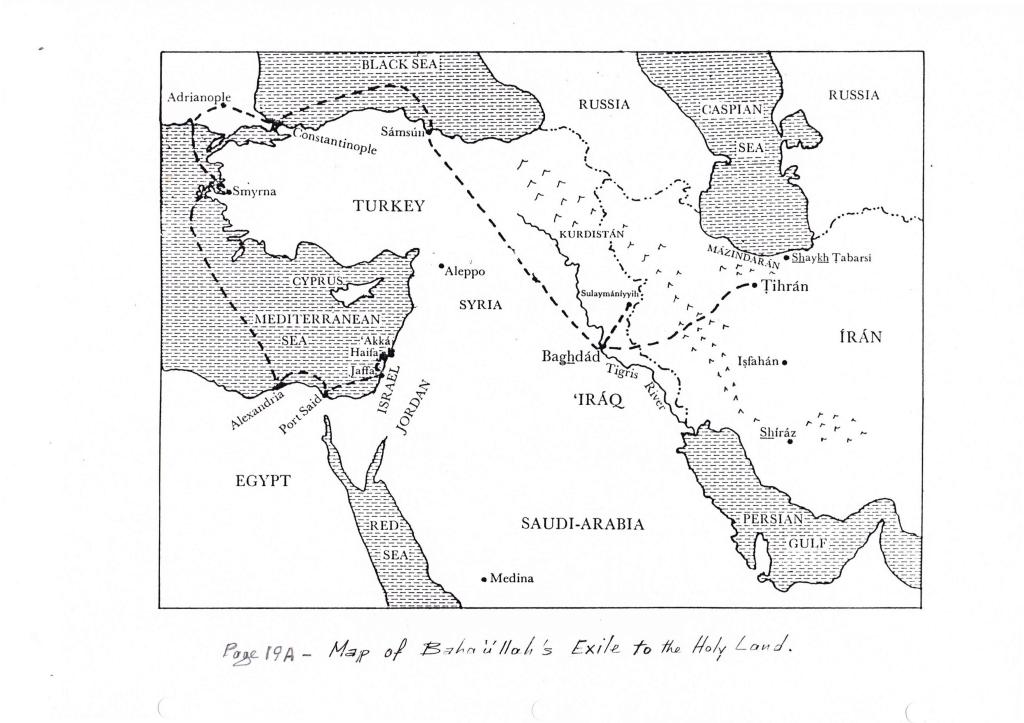
When Baha’u’llah retuned from Iraq, although then a second cousin of Baha’u’llah had become the country’s Prime Minister, He was not exempted. He was arrested and bastinadoed until His feet were bleeding. Entire of His possessions were confiscated. He was fettered in chain and marched a long distance from outside Tehran with bare feet on the hot stone streets of the hot summer of that city, while hostile mobs were insulting and stoning Him. He was marched to the notorious Siyah-Chal, (Black Dungeon) prison and put under a much heavier chain, a chain so infamous that it was even given a name, (Qhara-Kahar). It was of such a galling mass that one could not stand under its weight. Siyah-Chal with its famous chain was the worst of all dreadful nineteen century Persian prisons. Baha’u’llah was kept in that Dungeon for four months. There were five other believers of the Bab chained together with Baha’u’llah. Those five were publicly put to death like thousands of their fellow believers but Baha’u’llah’s life was miraculously spared, not by any intervention of His related Prime Minister but by the intervention of the Russian consulate in Tehran that had become aware of Baha’u’llah’s complete innocence. Baha’u’llah was banished from His native country to Baghdad, under the jurisdiction of the Turkish Empire. Notwithstanding that His body was weakened and had become ill during the ordeal in the torturous Black-Dungeon, He had to walk almost the entire winter of 1853 through the cold and snow covered Alvand mountains in western Iran accompanied by mounted guards. His exile in Baghdad lasted for ten years until the Ottoman government summons Him to Constantinople.
During the last twelve days of His exile in Baghdad, April 21 to May 2, 1863 Baha’u’llah revealed to His fellow believers that He was indeed, The Promised One heralded by the Bab. He proclaimed that by His revelation’ the prophesies of all previous revelations referred to as; the coming of Lord of hosts, the return of Krishna, the revelation of Husheedar, the coming of the fifth Buddha and the second coming of Jesus Christ had been fulfilled. Baha’u’llah announced that the promised ‘Kingdom of God on earth’ is but the establishment of His ‘New World Order’ throughout the planet. Those who were present together with close to one hundred percent of the adherents of the Bab elsewhere, gave their total allegiance to Baha’u’llah. Soon the new religion which until that time had spread only among Muslims, with the exception of one believer from Jewish faith, one from Christian faith and one from Hindu religion, was embraced by the followers of all religions and thereafter, they were called ‘Baha’is.
Baha’u’llah’s second banishment to Constantinople was followed by a third banishment to Adrianople and finally on August 12, 1868, Baha’u’llah together with His family and companions were sent to the prison city of Aka, Palestine, another colony of the Turkish Ottoman Empire. History describes Aka at that time in the following way:
“The most desolate of the cities, the most unsightly of them in appearance, the most detestable in climate and the foulest in water… So putrid was its air that according to a proverb, a bird flying over it would drop dead.”29
In fact Turkish authorities send to Aka those prisoners for whom they wished a gradual and torturous death, rather than a quick execution. The lack of sanitation, fresh water and the abundance of diseases insured the authorities wish. The prisoners could rarely survive for more than few years. All except His eldest son (Abdu’l-Baha) fell sick upon arrival and three died consequently. Baha’u’llah was confined in a solitary cell while the rest were jammed together in two rooms. The strict solitary imprisonment of Baha’u’llah in Aka lasted for two years. During that time Abdu’l-Baha was the only person permitted to visit Baha’u’llah. In the history of Baha’i Revelation we read:
“’It is difficult’, declares Abdu’l-Baha, ‘to understand how Baha’u’llah could have been obliged to leave Persia and to pitch His tent in this Land, but for the persecution of enemies, His banishment and exile. Indeed such a consummation, He assures us had been prophesied through the tongue of the prophets two or three thousand years before. ‘God faithful to His promise, had to some of the prophets revealed and given the good news that the Lord of hosts should be manifest in the Holy Land.’ … David in his Psalms had predicted; ‘Lift up your heads, O ye gates, even lift them up, ye everlasting doors, and the King of Glory shall come in. Who is this King of Glory? The Lord of hosts, He is the King of Glory.’”30
“Aka itself flanked by the ‘glory of Lebanon’ and lying in the full view of the splendour of Carmel, at the foot of the hills which enclosed the home of Jesus Christ Himself had been described by David as ‘the strong city.’ Designated by Hosea as ‘a door of hope’ and alluded to by Ezekiel as the gate that looketh toward the East’ whereunto ‘The Glory of God31 of Israel came from the way of East32, His voice like a noise of many waters’ “The banishment lasting no less than twenty four years, … Witnessed a miraculous and truly revolutionizing change in the circumstances attending the life of the exile Himself, will be chiefly remembered for the widespread recrudescence of persecution, intermittent but singularly cruel, throughout His native country and the simultaneous increase in the number of His followers and lastly for an enormous extension in the range and volume of His writings.”33
Explicit orders were issued by the Sultan dated, July 26, 1868, before their arrival to Aka, to subject Baha’u’llah to the strict confinement and forbidding His exile companions from any association with the inhabitants of Aka. Baha’u’llah’s prison cell was a small room with stone walls and floor in a fortified barrack that is kept today in its original conditions. No need to add that Ottomans did not provide any bed or other facilities for their prisoners and Baha’u’llah had to sleep on that rough floor for two years.
Despite the imposed ban, few of the followers of Baha’u’llah managed to reach the gates of prison and content themselves with a glimpse of the face of their Beloved from the barred window of His cell. One day an old pilgrim posted himself on the side of a moat gazing for hours in rapt adoration at the window of the cell, but he failed at the end, owing to the feebleness of his eye sight to discern the face of his Beloved. This episode moved to tears the companions of Baha’u’llah who were watching the frustration of the old man from inside of the barracks. A short time later, a new bitter grief was added to the tribulations of Baha’u’llah, the loss of the noble and pious twenty two years old son of Baha’u’llah, Mirza Mehdi. He was immersed in his customary devotion on the roof of the barracks, when he fell through an unguarded skylight onto a wooden crate on the floor beneath which pierced his ribs and caused his death twenty two hours later. His dying supplication to the Father Who was just allowed to see His injured son, was that his life might be accepted as a ransom for those who were prevented from attaining the presence of their Beloved. Four months after this tragedy, a mobilization of Turkish troops required the removal of the prisoners from the barracks. Baha’u’llah and His companions consequently were moved into a small house within the walls of the city of Aka, ending the solitary imprisonment of Baha’u’llah. In a short period Baha’u’llah and His companions were moved a few times by the authorities into different houses.
Gradually all elements of the population of Aka recognized the complete innocence of Baha’u’llah and His companions. The new governor of Aka, Ahmed Big Tawfig had become so devoted to Baha’u’llah, that he never entered His presence without asking ahead for permission through Abdu’l-Baha, then in His early thirties. Bigots were angered that the governor entered the presence of Baha’u’llah with such a humbleness, if though he was one of His followers. The governor had developed such attachment to the gentle and loving personality of Abdu’l-Baha that he was sending his son for enlightenment to Abdu’l-Baha. The Mufti (Judge) of Aka, Shaykh Mahmud was converted to the faith of Baha’u’llah and became such a devoted believer that he made a compilation of the Prophet Mohammad’s traditions regarding Aka, that it would be honoured with the footsteps of the promised one. The colonel commander of the prison guard, joined the followers of Baha’u’llah. The subsequent governors went even further. Although the sentence of life imprisonment of Baha’u’llah was never lifted by the Ottoman government, Mustafa Diya Pasha who later became governor, had gone so far as to declare that the Prisoner was free to pass the city gates. Aziz Pasha who in Adrianople had gain an attachment to Abdu’l-Baha, then only twenty two years old and had been promoted to rank of Vali, (Provincial governor) twice visited Aka for the expressed purpose of paying his respect to Baha’u’llah and to renew his friendship with Abdu’l-Baha.
Baha’u’llah had such an influence on the people of Aka that they refer to Him ‘His Highness’, ’The August Leader’. On one occasion, a European general who together with the governor was granted an audience with Baha’u’llah, was so impressed that he remained kneeling during his visit in spite of his European tradition and high rank. With repeated supplications by Abdu’l-Baha and perseverance of the judge of Aka, who was converted to the Faith, Baha’u’llah eventually moved from within the prison city of Aka to a suburban palace, called the mansion of Bahji. It was in this mansion that the distinguished British orientalist Professor Edward G. Brown of Cambridge, (a non-Baha’i scholar) was granted his four successive interviews with Baha’u’llah, April 15 – 19, 1890. The details of these historic interviews are recode and published by Professor Brown and are reprinted in ‘God Passes By’ by Shoghi Effendi,
“… interviews immortalized by the Exile’s historic declaration that ‘these fruitless strives, these ruinous wars shall pass away and the most Great Peace shall come’. ‘The face of Him on whom I gazed,’ (is the interviewer’s memorable testimony) ‘I can never forget, though I cannot describe it. Those piercing eyes seemed to read one’s very soul; Power and authority sat on that ample brow. … No need to ask in whose presence I stood, as I bowed myself before one who is the object of a devotion and love which kings might envy and emperors sigh for in vain’ . Here, did I spend five most memorable days… It was in truth a strange and moving experience, but one whereof I despair of conveying save the feeble impression.”34
Baha’u’llah himself writes of the remarkable reversal in the circumstances of His exile and imprisonment in Aka:
“The Almighty …. hath transformed this prison house into the most exalted Paradise, the Heaven of Heavens.”35
Ascension and the Covenant of Baha’u’llah
Baha’u’llah left His human temple three hours after midnight on May 29, 1892. A telegram bore the news to the Sultan of Turkish Empire as: “The Sun of Baha has set.” For a full week a vast number of mourners from Aka to as far as Damascus, Aleppo, Beirut and Cairo, from all walks of life; rich, poor and noblemen from diverse religions; Jews, Christians, Moslems and Druzes as well as the government officials including governors all joined to pay respect to the One they gradually learned to admire. In His will and testament, Baha’u’llah appointed His eldest Son, Whom we know as Abdu’l-Baha, as the centre of His covenant and the interpreter of His revealed words. Abdu’l-Baha was raised and taught by Baha’u’llah. During Baha’u’llah’s solitary imprisonment, Abdu’l-Baha was the only one allowed to visit Him. Besides His revealed words, Baha’u’llah presented to mankind, Abdu’l-Baha as the exemplar of a perfect Baha’i. The covenant of Baha’u’llah together with His revealed words and His administrative order have proven to be the powerful unifying forces within the Baha’i Faith, an impenetrable stronghold against sectarianism and disunity. Baha’i Faith unity is the indicative of ‘Unity of Mankind’.
Writings of Baha’u’llah
During Baha’u’llah’s exile in Baghdad, Constantinople, Adrianople and Aka, He revealed several books, tablets and prayers, truly an ocean of spirituality enhanced with the pearls of knowledge and wisdom. Among the first was the ‘Book of Certitude’ that was revealed during His exile in Baghdad. Shoghi Effendi wrote: “This book, setting forth in outline the Grand Redemptive scheme of God…”36 Next to this treasure is the collection of gem-like utterances known as the ‘Hidden Words of Baha’u’llah’ Words to reorient the mind, edify the soul and purify the conducts of man. During the same period in Baghdad, two treatises of mystical compositions also were revealed by Baha’u’llah, known as the ‘Seven Valleys’ and ‘Four Valleys’, revealed as answers to the mystical questions of a Kurdish mystical leader. During His exile in Adrianople, Baha’u’llah revealed letters, known as Tablets to the rulers and the religious leaders of the world as well as to the mankind as a whole, proclaiming His Heavenly Mission. Baha’u’llah’s incarceration in the prison fortress of Aka in spite of its manifold tribulations for the first few years and continuous agonizing news of the persecutions and ordeals of His followers in Iran, (at the present 2022 the persecutions and ordeals of Iran’s Baha’is still continues), did not impede the mighty stream of the Divine Revelation. Shoghi Effendi classifies the writings of Baha’u’llah during His twenty four years incarceration and exile in Aka, into three distinct categories:
The first are the continuation of His proclamation in Adrianople. The second includes the laws of His Dispensation that for the most part are recorded in His Ketabi Aghdas. The third are regarding the fundamentals of His Dispensation. About ‘The Most Holy Book’ of Baha’u’llah, Shoghi Effendi writes:
“… the principle repository of that law which the Prophet Isaiah had anticipated, and which the writer of Apocalypse had described as the ‘new heaven’ and the ‘new earth’ as the ‘Tabernacle of God’, as the ‘Holy City’, as the ‘Bride’, the “New Jerusalem coming down from God’.37
The Teachings of Baha’u’llah
Baha’u’llah has revitalized the human spirituality by reviving the spring time of a new spiritual cycle and belief in people’s heart. At the outset of His revelation, almost all His followers were believers of the Bab who were converted from Islam only a short time earlier. In the revelation of His new teachings, changing the teachings of the former dispensations, there is a wisdom that Baha’u’llah Himself explains:
“Consider the sun. How feeble its rays the moment it appeareth above the horizon. How gradually its warmth and potency increase as it approacheth its zenith, enabling meanwhile all created things to adapt themselves to the growing intensity of its light… Were it all of a sudden to manifest, the energies latent within it, it would no doubt, cause injury to all created things… In like manner, if the Sun of Truth were suddenly to reveal, at the earliest stages of its manifestation, the full measure of the potencies which the providence of the Almighty hath bestowed upon it, the earth of human understanding would waste away and be consumed!”38
Based on the above gracious wisdom, Baha’u’llah adopted a few of the former religious laws with some revisions or added conditions to change or even abrogate them. For example, Baha’u’llah adopted Bab’s calendar of nineteen months of nineteen days each, but added four/five days of festivity and felicity (called intercalary days) to that calendar in order to coincide it with the natural solar year. Another example; Out of His high respect for The Bab, Baha’u’llah brought a similar to Bab’s inheritance law in His Holy book, but added that the believers should write their own will and decide upon their own inheritance. New teachings, contrasting then with accepted beliefs, such as equality of rights of men and women and abolishing religious hierarchy with clergies in the Baha’i faith and replacing it with the Baha’i administration, were revealed later as well.
Baha’u’llah exhorts His followers to consort with amity, without discrimination with all mankind. Inculcates upon them; strict truthfulness, spotless chastity, trustworthiness, hospitality, fidelity, courtesy, forbearance, tolerance and the individual and social justice. He teaches the belief in God and love of the Creator, to love fellow human beings, kindness , modesty, and He condemns; cruelty to animals, excessive hunting, idleness, sloth, gossip, backbiting and calumny. He abolishes the institution of priesthood in the Baha’i Faith, prohibits slavery, the use of intoxicating drugs and drinks for other than as medicine. He censures divorce and interdicts gambling, forbids murder, arson, adultery, theft, the use of gross language, insult and assault. He stresses the importance of marriage and lays down its essential conditions. He imposes the obligation of engaging in work’ exalting useful occupation to the rank of worshipping God, emphasizes the necessity of providing the means for the education of children and obedience to one’s government. He declares that the true liberty consists in man’s submission to His commandments. Prescribes the twin and inseparable duties of mankind in recognizing the “Dayspring of God’s Revelation” and of observing all ordinances revealed by Him. That neither of these twin duties is accepted without the other.39 He defines justice as the light of man and their guardian, as the revealer of the secrets of the world of being and the standard-bearer of love and bounty. He declares that the light of justice and its radiance to be incomparable. Affirms that upon justice must depend the organization of the world and its tranquility. Warns the people of the world to bestir themselves in anticipation of its advent as he prophesies that after an interval of great turmoil and grieves injustices, its daystar will shine in full splendour. He further inculcates the principle of moderation in all things, declares that “Whatever; be it liberty, civilization and the like, passes beyond the limits of moderation, must exercise a pernicious influence upon man”40
Baha’u’llah establishes consultation as one of the fundamental principles of His Faith. “Knowledge” He states, “is as wing to man’s life and a ladder for his ascend”41 Its acquisition He regards as incumbent upon every one. Considers; arts, crafts and sciences to be conducive to the exaltation of the world of being and commends the wealth acquired through crafts and profession. Acknowledges the indebtedness of the people of the world to scientists and craftsmen but discourages such studies that are unprofitable to men, that “begins with words and end with word,”42 Those and other spiritual, moral and social teachings plus following, each with a brief explanation are what Baha’u’llah prescribes as saviour for the present era of the human society.
Investigation of Truth
Baha’u’llah invites the individual members of the human family to investigate the truth of His mission independently and free from the fetters of imitations, prejudices and preconceptions. Abdu’l-Baha in a recorded speech said:
“First among the great principles revealed by Him is that of the investigation of the reality. The meaning is that every individual member of humankind is exhorted and commanded to set aside superstitious beliefs, traditions and blind imitation of ancestral forms of religion and investigate reality for himself.”43
Baha’u’llah exhorts the seeker of truth:
“When a true seeker determines to take the steps of search in the path leading to the knowledge of the Ancient of days, he must before all else, cleanse and purify his heart, which is the seat of the revelation of the inner mysteries of God. … He must so cleanse his heart that no remnant of love or hate may linger therein, lest that love blindly incline him to error or that hate repel him from the truth.”44
Abolition of Prejudices
Baha’u’llah’s authoritative interpreter, Abdu’l-Baha, said:
“Prejudice whether it be religious, racial, patriotic or political in its origin and aspects is the destroyer of human foundation and opposed to the command of God … All the heavenly books are the written word of love. If they prove to be the cause of prejudice and human estrangement, they have become fruitless. Therefore the religious prejudice is especially opposed to the will and command of God. Racial and national prejudices which separate mankind into groups and branches, likewise have a false and unjustifiable foundation.”45
Religions Must be the Cause of Love and Accord
Baha’u’llah wrote:
“O ye children of men, the fundamental purpose animating the Faith of God and His Religion is to safeguard the interests and promote the unity of the human race, and to foster the spirit of love and fellowship amongst men. Suffer it not to become a source of dissension and discord, of hate and enmity.”46
He admonishes His followers:
“Consort with all men, O people of Baha in a spirit of friendliness and fellowship. If ye be aware of a certain truth, if ye possess a jewel of which others are deprived, share it with them in a language of utmost kindliness and goodwill. If it be accepted if it fulfills its purpose, your object is attained. If anyone should refuse it, leave him unto himself, and beseech God to guide him. Beware lest ye deal unkindly with him.”47
In Abdu’l-Baha’s words:
“If religion becomes a cause of dislike, hatred and division, it were better to be without it, and to withdraw from such a religion would be a truly religious act.”48
Religion in Harmony with Wisdom and Science
Science is about the material world, a creation of God, and religion deals with spiritual subjects, another created world of God. Baha’u’llah teaches that the creation of God is perfect for its purpose. For example, the natural laws are the necessary relations of entities and unlike man-made laws that have to allow exemptions for unpredicted situations, “This nature is subject to an absolute organization, to determine laws, to complete order and a finished design from which it will never depart.”49 Therefore, imagining that God for fulfilling a spiritual purpose has to defy natural laws is to regard the creation of God imperfect, needing exemptions. Abdu’l-Baha explains:
“The teachings of Baha’u’llah announce that religion must be in conformity with science and reason. Otherwise it is superstition, for science and reason are realities and religion itself is the Divine Reality unto which true science and reason must conform. God has bestowed the gift of mind upon man in order that he may weigh every fact or truth presented to him and adjudge whether it be reasonable. That which conforms to his reason he may accept as true, while that which reason and science cannot sanction may be discarded as imagination and superstition, as a phantom and not reality. Inasmuch as the blind imitations or dogmatic interpretations current among man do not coincide with the postulate of reasons, and the mind and scientific investigation cannot acquiesce thereto, many souls in the human world today shun and deny religion.”50
“There is no contradiction between true religion and science. When a religion is opposed to science it become mere superstition. That which is contrary to knowledge is ignorance. How can a man believe to be fact, what science has proven impossible?… The true principles of all religions are in conformity with the teachings of science.”51
He further assures that:
“Our Father will not hold us responsible for the rejection of dogmas which we are unable either to believe or comprehend, for He is ever infinitely just to His children.” 52
Mankind is in Need of Divine Guidance
Man’s natural instincts such as self-preservation, ambitions, sexual desire, fear, and anger are all necessary characteristics. Self-preservation causes us to protect our own life and ambitions help us to grow and progress; these two phenomena result in individual and social achievements and advancement. Sexual desire is the cause of humankind life continuation. Fear is a cause of safety and courage, even anger is needed to overcome excessive and harmful fear. These instincts are powerful and every one of them, when unchecked, can have negative effects. Uncontrolled selfishness is the cause of jealousy, prejudice, tyranny, murder, hatred, and even war. Uncontrolled sexual desire has proven to be the cause of sexual aggressions, even murder. Fear can become the reason for dishonesty, lying, apathy and so on. All other necessary and useful human characteristics and instincts without control have proven harmful. Therefore, the creation of man as only a physical entity with only worldly characteristics is imperfect and defective. Baha’u’llah teaches that the creation of man is complete because man as well as being a physical creature, is also a spiritual being. This spiritual nature of man comes to life only through the Divine teachings of the Manifestation of God. Since man’s desires are strong, a more powerful means is needed to control them. Each religion during its ‘God’s predetermined effective period’ has proven to be an extremely powerful instrument in man’s life. Abdu’l-Baha said:
“The holy Manifestations of God come into the world to dispel the darkness of the animal or physical nature of man, to purify him of his Imperfections in order that his heavenly and spiritual nature may become quickened, his divine qualities awakened’ his perfection visible, his potential powers revealed and all the virtues of the world of humanity latent within him come to life. … Were it not for the coming of these holy Manifestations of God, all mankind would be found in the plane of animals.”53
He also wrote:
“O ye concourse of the Kingdom of Abha. Two calls to success and prosperity are being raised,… One is the call of civilization, of the progress of the material world …The others the soul stirring call of God, Whose spiritual teachings are safeguards of the everlasting glory, the eternal happiness and illumination of the world of humanity and causes attribute of mercy to be revealed in the human world … However, until material achievements, physical accomplishments and virtues are reinforced by the spiritual perfections, luminous qualities and characteristics of mercy, no fruits or results shall issue therefrom. … On the other hand; dangers, severe calamities and violent afflictions are imminent.”54
Baha’u’llah admonishes that:
“In truth, religion is a radiant light and an impregnable stronghold for the protection and welfare of the people of the world, for fear of God impelleth man to hold fast to that which is good and shun all evil. Should the lamp of religion be obscured, chaos and confusion will ensue and the light of fairness and justice, of tranquility and peace cease to shine. Unto this will bear witness every man of true understanding.”55
He also wrote:
“ … and since there can be no tie of direct intercourse to bind the One True God with His creation, and no resemblance whatever can exist between the transient and the Eternal, the contingent and the Absolute, He hath ordained that in every age and dispensation a pure and stainless Soul be manifest in the kingdom of earth and heaven. Unto this subtile, this mysterious and ethereal Being He hath assigned a two fold nature; the physical pertaining to the world of matter, and the spiritual which is born of the substance of God Himself.”56
Devotion without Fanaticism and Superstition
Baha’u’llah exhorts His followers to devotion and observance of the moral conducts while at the same time He warns them against fanaticism, religious intolerance, prejudice, and superstitious imaginations. From the writings of Baha’u’llah it is clear that there is a distinct difference between being totally devoted and being fanatic. To be a devoted Baha’i is about one’s own life by reaching the station of certitude through knowledge and obedience to God’s commandments. Fanaticism on the other hand, is to do with interference with the life of others, same is with intolerance and prejudice57. Teachings of Baha’u’llah present an additional meaning for faith, a definition based on sound reasons. Instead of blind acceptance of a collection of dogmas, it is to investigate the truth of the Manifestation of God conscientiously then to study its holy writings to arrive at the station of faith. This station of certitude is also a spiritual achievement that requires prayers for assistance from God. That is certitude to the truth and infallibility of His Revelation.
Progressive Revelations and the Unity of Religions
All the Manifestations of God, Baha’u’llah teaches, are the revelations of the same Divine Will and have appeared for the same purpose, i.e. to guide mankind. This is the ‘Unity of Religions’. Successive revelations have been necessary since mankind’s level of understanding has continuously progressed, requiring new teachings, like successive school classes and teachers. Baha’u’llah explains:
“The Bearers of the trust of God are made manifest unto the peoples of the earth as the Exponents of a new cause and the Bearers of a new message. Inasmuch as these birds of the Celestial Throne are all sent down from the heaven of the Will of God, and as they all arise to proclaim His irresistible Faith, they therefore are regarded as one soul and the same person.“58
Immortality of the Human Spirit and Spiritual Progress
According to the teachings of the Baha’i faith, man is not simply an intelligent animal but also a spiritual being. Based on the Baha’i writings, our mind is under influence of our soul as well, thus freeing our mind from the domain and total control of nature’s determinism, enabling man to posses free will, to discover, to invent, to have human spiritual virtues. Without human spirit free will is impossible. The spiritual virtues are contrary to our carnal desires, the instincts that we share with animals. As an example, spiritual feelings like being unselfish to the degree to sacrifice our own advantages for the good of others and even for strangers, contrary to the evolutionary struggle for survival. These spiritual virtues are usually symbolized as heart feelings or understandings as we do not have a place for the spirit. Our free will makes us also able to do right or wrong. Abdu’l-Baha describes the spiritual world (Kingdom) in the following way:
“It is free from body and that which is corporeal, and it is purified and sanctified from the imagination of the human world. To be limited to place is a property of bodies and not spirit.”59
Abdu’l-Baha further explains:
“From the very birth of a human being the soul progresses, the intellect grows and knowledge increases. When the body dies the soul lives on. All differing degrees of created physical beings are limited, but the soul is limitless. … The whole physical creation is perishable. These material bodies are composed of atoms, when these atoms begin to separate decomposition sets in, then comes what we call death. With the soul it is different. The soul is not a composition of elements, it is not composed of many atoms, it is of one indivisible substance and therefore eternal. It is entirely out of the order of the physical creation. … “ Consider the aim of creation: Is it possible that all created to evolve and develop through countless ages with this small goal in view – a few years of man’s life on earth? Is it not unthinkable that this should be the final aim of existence? … “ Does a man cease to exist when he leaves the body? If his life comes to an end, then all the previous evolution is useless, all has been for nothing. Can one imagine that creation has no greater aim than this? The soul is eternal, immortal.”60
The immortality of the spirit of human and the purpose of life make so much sense, that during the twentieth century some religious organizations of the previous dispensations have adopted this teaching of Baha’u’llah as the truth, though it is unlike their previous beliefs, describing “Resurrection” at the ‘Day of End’ a physical resurrection of dead people.
Equality of the Rights and Privileges of Men and Women
The present unwritten but widely practiced and in some societies even enforced traditions violate the equal rights and privileges for women everywhere and more importantly at homes. Legislations cannot change this practice at homes to truly make wife and husband equal and to encourage daughters as much as sons in their education, achievements, right ambitions and self-esteem. In social relations as well, equal right laws cannot be sufficiently effective since an intentional or unintentional prejudiced decision can appear to be based on some other legitimate reasons. Only Divine guidance can penetrate every home and heart. Abdu’l-Baha explains the above teaching:
“In proclaiming the oneness of mankind He (Baha’u’llah) taught that men and women are equal in the sight of God and there is no distinction to be made between them. The only difference between them now, (1912) is due to lack of education and training. If woman is given equal opportunity of education, distinction and inferiority will disappear. The world of humanity has two wings as it were, one is the female, the other is the male If one wing be defective the strong wing will not be capable of flight. The world of humanity has two hands. If one be imperfect the capable hand is restricted and unable to perform duties. God is the creator of mankind. He has endowed both sexes with perfections and intelligence, … In this day there are women among Baha’is who far outshine men. They are wise, talented, well informed, progressive, most intelligent and the light of men. They surpass men in courage. When they speak in meetings, the men listen with respect. Furthermore, the education of women is of greater importance than the education of men, for they are the mothers of race and mothers rear the children. The first teacher of children are mothers. Therefore, they must be capably trained in order to educate both sons and daughters… Daughters and sons must follow the same curriculum of study, thereby promoting the unity of sexes. When all mankind shall receive the same opportunity of education and the equality of men and women be realized, the foundation of war will be utterly destroyed.”61
According to the Baha’i precepts except for one particular case; the membership of the Universal House of Justice that indeed it is a hard job rather than a right or privilege, there is no distinction between men and women. There is a promise in the Baha’i holy writings that in the future the reason for this Divine wisdom will become known. This should also be noticed that unlike the previous religious hierarchies, that the theologians are religious leaders with designated high stations and authorities, only the Baha’i administration institutions are the authorized organizers of the community, their elected members have no special status or any leadership position. Their stations is exactly the same as any other community member. I do not think there is any harder work and heavier responsibilities than being a member of the Universal House of Justice without any individual power or privilege.
Universal Education
Baha’u’llah sets a minimum for the children education, prescribes a universal education system and highly encourages the acquisition of knowledge, professions, sciences, arts and crafts:
“O people of Baha! The reflective faculty is the depository of craft, arts and sciences. Exert yourselves, so that the gems of knowledge and wisdom may proceed from this ideal mine and conduce to the tranquillity and union of the different nations of the world.”62
Universal Language and Script
Another teaching of Baha’u’llah is the adoption of a universal language as well as a universal script. He instructs mankind:
“Adopt one of the existing languages or a new one to be taught to the children in schools throughout the world, and likewise a new script. Thus the whole earth will come to be regarded as one country!”63
This teaching is simple to understand and accept but its enormous future benefits may not at the present be fully appreciated. A universal language will definitely be a great step towards international understanding and good relations. Following is an interesting trend to observe since Baha’u’llah wrote this teaching over one hundred fifty years ago. At that time a tiny fraction of the world population studied a second language. Although the number of those students of a second language was small, the languages that they were learning besides their mother tongues were various and numerous. Almost all were studying the language of a neighbouring country. During this one hundred fifty years the number of the students of a second language has been increasing, reaching to a significant percentage of the world population, in spite of that, the number of languages taken as a second language has been decreasing. Today only two or three languages are being studied as a second language by all those students. The tendency is towards one auxiliary world language.
Universal Peace and International Court
Baha’u’llah taught that universal and everlasting peace is one of the pillars of the ‘Unity of Mankind’, the hallmark and pivot of His teachings. He advised that a ‘lesser peace’ could be achieved by a mutual agreement between the governments in the world before the advent of the ‘Universal Peace’ as planned and prophesied in the Baha’u’llah’s ‘New World Order’. An international court of appeal is a part of lesser peace plan of Baha’u’llah. Abdu’l-Baha wrote:
“Know ye, verily that the happiness of mankind leith in the unity and the harmony of human race and that spiritual and material developments are conditioned upon love and amity among all men. … A critic may object saying that peoples, races, tribes and the communities of the world are of different and varied customs, habits’ tastes, characters, inclinations and ideas. That opinions and thoughts are contrary to one another, and how therefore is possible for real unity to be revealed and perfect accord among human souls to exist? In answer we say that differences are of two kinds. One is the cause of annihilation and is like antipathy existing among warring nations and conflicting tribes who seek each other destruction, uprooting one another’s families, depriving one another of rest and comfort and unleashing carnage. The other kind which is a token of diversity is the essence of perfection and the cause of appearance of the bestowals of the Most Glorious Lord.”
“Consider the flowers of a garden; though differing in kind, colour and shape, yet inasmuch as they are refreshed by the waters of one spring, revived by the breath of one wind, invigorated by the rays of one sun, this diversity increaseth their charm, and addeth onto their beauty. Thus when that unifying force, the penetrating influence of the word of God, taketh effect, the differences of customs, manners, habits, ideas, opinions and dispositions embellisheth the world of humanity. … Diversity of hues, form and shape enricheth and adorneth the garden, and heightenth the effect thereof. In like manner, when diverse shades of thoughts, temperament and characters are brought together under the power and influence of one central agency, the beauty and glory of human perfection will be revealed and made manifest. Naught but the central potency of the word of God, which ruleth and transcendeth the reality of all things, is capable of harmonizing the divergent thoughts, sentiments ideas and convections of the children of man.”64
Abdu’l-Baha also wrote:
“War is death, while peace is life, war is rapacity and bloodthirstiness while peace is beneficence and humanness, war is an appurtenance of the world of nature while peace is of the foundation of the religion of God.“65
Individual and Social Justice
In human relations we feel the agonies of injustice when we are victims, but often we neglect to see our own unfairness. Social injustice towards groups of people and even towards nations is unfortunately abundant in the present world situation. Individual and social justice are emphatically taught by Baha’u’llah. In His ‘New World Order’, justice will be the governing power in the relationship between individuals and between nations, between supervisor and subordinates, between employer and employee and between peoples and governments. These are the words of Baha’u’llah:
“We cherish the hope that the light of justice may shine upon the world and sanctify it from tyranny. … There can be no doubt whatever that if the daystar of justice which the clouds of tyranny have obscured, were to shed its light upon men, the face of earth would be completely transformed.”66
Baha’i Administration
During the former dispensations the mass of population were illiterate, unable to understand holy writings, therefore priesthood was established to lead the masses spiritually. With the eventual universal literacy in this dispensation the institution of clerical is no more required and has been abolished. Instead, Baha’u’llah has established a Baha’i Administration Order that governs and organizes the Baha’i communities spiritually. However, this administration is not a substitute for priesthood, since it is the responsibility of each believer to pursue her/his own spiritual education more over, its function, organization and electoral process are widely different from that of any former religious hierarchy. In each locality where nine or more adult Baha’is reside, a local ‘Spiritual Assembly’ is elected by secret ballot (once a year at present). When an adequate number of local spiritual assemblies are formed in a country, a national spiritual assembly is elected by all adult Baha’is through delegation. Members of all national spiritual assemblies from around the globe meet once every five years as national delegates to elect members of the supreme body of the Baha’i world, the Universal House of Justice. The nature of the voting in the Baha’i administration is personal and confidential to the degree that even wife and husband are not to be aware of each other’s vote. One may ask is this possible? The answer is definitely! Baha’is do it because of their faith, because of their belief! Unlike political elections there is no campaign or nomination. In each locality, instead of candidates seeking votes from the electors, it is the sacred duty of each individual Baha’i to conscientiously and prayerfully search and vote for the individuals who on elector’s opinion have the best qualities to serve in the institution. In the Baha’i administration the elected institutions guide and organize the community activities and unlike religious hierarchies that the religious leaders have special stations and authorities, the elected members of these institutions individually do not have any special station, leadership or authority. The detailed nature of the Baha’i administration and its elections are beyond the scope of this article. In brief, the Baha’i administration is the Divinely ordain institution through which the prophesy of the ‘Kingdom of God on earth’ shall be established. Shoghi Effendi wrote:
“This Administration Order, unlike the systems evolved after the death of the Founders of the various religions, is Divine in origin, rest securely on the laws, the precepts, the ordinances and institutions which the founder of Faith Himself specifically laid down and unequivocally established, and functions in strict accordance with interpretations of the authorized interpreters of its holy scriptures, unique in the annals of the world religious history, succeeded in maintaining the unity of diversified and far-flung body of its supporters.“67
The involvement of the entire Baha’i community in the undertaking of the Faith and the interface between the administration and the individual believers is made possible, systematically, easily and well accomplished at a regular community gathering known as the ‘Community Feast’ that is ordained by Baha’u’llah and held every 19 days in all Baha’i communities. Each feast is comprised of three parts; devotional period, administrative period and the social period. The administrative period is for communications between the administrative institutions and the community members. On one hand, announcements and other communiques from the institutions are read and on the other hand, the community members voice their questions, recommendations and suggestions that could be on local, national or even on the International subjects which are channeled to the related institution. This is the most effective, while simple and systematic method for individuals to make their ideas known and participate for the betterment of their local or national community or even on the world subjects.
Baha’i Solutions to Economic Problems
The root cause of almost all economic ailments are man misconducts. Even personal economic difficulties are rarely caused by any out of control events. When we investigate these problems with fairness we can detect dishonesty, greed, unfairness and other moral ailments at the root of the economic difficulties. Here are a few questions to ponder; Is not greed mostly the cause of inflation? Why so often are hard working people like farmers who produce the vital products, teachers with one of the most important services or scientists, are with relatively meagre income, while some professions with negligible or no benefit for societies have very high earnings? Does not that attract talented and hard working students to less useful with high income occupations? Have not rigid economic systems ended in dictatorship? Isn’t justice missing? Those wrongs are moral problems that need spiritual remedies.
The Baha’i Faith is not an economic system but the spirituality, justice and moral conscience that it inspires in the hearts of its adherents, together with numerous teachings which directly effect the fabric of a future economic relations is both remedy to the world economic ailments and principles for a new one. The future economists will make an economic system with regards to the spiritual teachings of Baha’u’llah, suitable to the ‘New World Order’ of Baha’u’llah.’ Here we can but briefly mention some of its aspects. Baha’u’llah teaches moderation and readjustment in the distribution of wealth but does not prescribe absolute equality and encourages earning of wealth through earnest professions:
“A financier with colossal wealth should not exist, while near him is a poor man in dire necessity.When we see poverty allowed to reach to a condition of starvation, it is a sure sign that somewhere we shall find tyranny.”68
Social and individual justice taught by Baha’u’llah will be a part of the devout belief of individuals thus eliminating economic injustice. It ensures impartiality and fairness in personnel evaluations in business organizations and consequently a proper utilization of the talents and knowledge of employees. This benefits both business and society. Idleness is forbidden by Baha’u’llah and work being equalled in rank to the act of worshiping God:
“It is enjoined upon every one of you to engage in some form of occupation such as crafts, trades and the like. We have graciously exalted your engagement in such work to the rank of worship unto God, the true One. … Waste not your time in idleness and sloth. Occupy yourselves with that which profiteth yourselves and others.”69
Human relations is one of the greatest factors in productivity; Baha’i morality and motive for service will revolutionize those relations. Moralities and motives that are based on justice, equity, righteousness, trustworthiness, honesty, abstinence from backbiting and slander plus elimination of prejudices. Justice alone will have an inestimable effect on economy. Baha’u’llah prescribed profit sharing for employees which is now being tried by few industries. Baha’u’llah discourages waste and advises moderation in loan interest rates. The spirit of love and accord, obedience and respect for laws, respect and compliance to the authorities at all levels, politeness, the encouragement of education in crafts and sciences and other moral teachings will have inestimable effects on economy. Equal opportunities for men and women will result in a far better utilization of the talents of one half of population. A world free from destructive effects of warfare will be able to channel enormous amount of wealth, material and labour presently wasted on armaments into fruitful enterprises. Trustworthiness both at individual and society levels means business will not charge consumers as much as the ‘market bears!!’ nor will industry produce obsolescent, short lasting products, wasting precious resources, energies and labour in an evil way of selling more. Instead industries will cooperate to serve people. As an example, millionaire owners/directors of industries would make durable and reusable plastic jugs, buckets, containers etc. for products instead of throw-aways in order to protect the environment, instead of making decisions solely based on generating extra wealth, which they do not need. Those are not mere good wishes, those are the unerring God’s plan. They are the religious laws that have proven to be very effective and self-enforcing!
The Unity of Mankind
The consummation and goal of social teachings of Baha’u’llah is the unity of mankind. Shoghi Effendy wrote:
“Humanity, whether viewed in the light of man’s individual conduct or in the existing relationship between organized communities and nations, has alas, strayed too far and suffered a too great a decline to be redeemed through the unaided efforts of the best among its organized rulers and statesmen. … Nor would any general scheme of mere organized international cooperation, in whatever sphere of human activity, however ingenious in conception, or extensive in its scope, succeed in removing the root cause of the evil that has so rudely upset the equilibrium of present day society. … “What else, might we not confidently affirm, but the unreserved acceptance of the Divine program enunciated, with such simplicity and forces as far as sixty years ago (Written in 1931), by Baha’u’llah, employing in its essentials God’s Divinely appointed scheme for the unification of mankind in this age, coupled with an indomitable conviction in the unfailing efficacy of each and all of its provisions, is eventually capable of withstanding the forces of internal disintegration which if unchecked must needs continue to eat into the vitals of a despairing society. It is towards this goal – the goal of a ‘New World Order’ Divine in origin, all-embracing in scope, equitable in principle, challenging in its features – that a harassed humanity must strive…’
…‘ The Tabernacle of unity’ Baha’u’llah proclaims in His message to all mankind, ‘has been raised, regard ye not one another as strangers … Of one tree all ye are the fruits and of one bough the leaves. … The world is but one country and mankind its citizens. … ‘ Let not a man glory in that he loves his country, let him rather glory in this, that he loves his kind.’ “Let there be no misgiving as to the animating of the purpose of the worldwide law of Baha’u’llah. Far from aiming at the subversion of the existing foundations of societies, it seeks to broaden its basis, to remould its institutions in a manner consonant with the needs of ever-changing world. It can conflict with no legitimate allegiances, Nor can it undermine essential loyalties. Its purpose is neither to strife a sane and intelligent patriotism in men’s heart, nor to abolish the system of national authority so essential if the evils of excessive centralization are to be avoided. It does not ignore, nor does it attempt to suppress, the diversity of ethnical origins, of climate, of language and traditions, of thought and habits, that differentiate the peoples and the nations of the world. It calls for a wider loyalty, for a larger aspiration than any that has animated the human race. It insists upon the subordination of national impulses and interests to the imperative claim of a unified world. It repudiates excessive centralization on one hand, and disclaims all attempts at uniformity on the other hand. Its watchword is unity in diversity such as Abdu’l-Baha Himself has explained. “Consider the flowers of a garden. Though differing in kind, colour, form and shape, yet, this diversity increaseth their charm and addeth unto their beauty.” … “let there be no mistake. The principle of Oneness of mankind – the pivot round which all the teachings of Baha’u’llah revolve – is no mere outburst of ignorant emotionalism or an expression of vague and pious hope. Its appeal is not to be merely identified with reawakening of the spirit of brotherhood and goodwill among men, nor does it aim solely at the fostering of harmonious cooperation among individual peoples and nations. Its implications are deeper, claims greater than any which the prophets of old were allowed to advance. Its message is applicable not only to the individuals, but concerns itself primarily with the nature of those essential relationships that must bind all the states and nations as members of one human family. It does not constitute merely the enunciation of an ideal, but stands inseparably associated with an institution adequate to embody its truth, demonstrate its validity, and perpetuate its influence. … “It represents the consummation of human evolution – an evolution that has had its earliest beginnings in the birth of family life, its subsequent development in the achievement of tribal solidarity, leading in turn to the constitution of city-state, and expanding later into the institution of independent and sovereign nations.”
“The principal of the Oneness of mankind, as proclaimed by Baha’u’llah, carries with it no more and no less than a solemn assertion that attainment to this final stage in this stupendous evolution is not only necessary but inevitable, that its realization is fast approaching, and that nothing short of a power born of God can succeed in establishing it. … and what voice other than that of Baha’u’llah – the Mouthpiece of God for this age – is capable of effecting a transformation of a society as radical as that which He has already accomplished in the hearts of those men and women, so diversified and seemingly irreconcilable, who constitute the body of His declared followers throughout the world. … That its modest beginning have already taking shape in worldwide administration with which the adherents of the Faith of Baha’u’llah stand associated, only those whose hearts are tainted with prejudice can fail to perceive.”70
World Order of Baha’u’llah as the Establishment of the Kingdom of God on Earth
Shoghi Effendi describes in an address to the Baha’is of the world, as much as could be presently understood about the future World Order of Baha’u’llah:
“The unity of human race, as envisaged by Baha’u’llah, implies the establishment of a world commonwealth in which all nations races creeds and classes are closely and permanently united, and in which the autonomy of its state members and their personal freedom and initiatives of the individuals that compose them are definitely and completely safeguarded. This commonwealth must, as far as we can visualize it, consist of a world legislature, whose members will as the trustees of the whole mankind, ultimately control the entire resources of all the component nations and will enact such laws as shall be required to regulate the life, safety, the needs and adjust the relationships of all races and peoples. A world executive backed by an international force, will carry out the decisions arrived at, apply the laws enacted by this world legislature, and will safeguard the organic unity of the whole commonwealth. A world tribunal will adjudicate and deliver its compulsory and final verdicts in all and every dispute that may arise between the various elements constituting this universal system. … A world metropolis will act as the nerve centre of a world civilization, the focus towards which the unifying forces of life will converge and from which its energizing influence will radiate. A world language will either be invented or chosen from among the existing languages and will be taught in the schools of all federated nations as an auxiliary to their mother tongues. A world script, world literature, a uniform and universal system of currency, of weights and measures, will simplify and facilitate intercourse and understanding among the nations and races of mankind. In such a world society, science and religion, the two most potent forces in human life, will be reconciled, will cooperate, and will harmoniously develop. The press under such a system, while giving full scope to the expression of the diversified views and convictions of mankind, ceased to be mischievously manipulated by vested interests, whether private or public, and will be liberated from the influence of contending governments and peoples. The economic resources of the world will be organized, its markets will be coordinated and developed and the distribution of its products will be equitably regulated.”71
Teachings of Baha’u’llah in Practice
The Baha’i Faith is established in well over 400 countries and independent territories, spreading over 100,000 localities around the globe (based on year 2000 statistics). It has become the most widespread religion on the planet after Christianity, and because of its teachings, it is considered the “World Religion”. Baha’i children are educated in the fundamentals of the Faith, and like non-Baha’is are free to join the Faith of Baha’u’llah after the age of maturity, instead of being considered Baha’is by birth, thus putting the principle of the ‘Independent Search after Truth’ into practice. Coming from diverse backgrounds, Baha’is rid themselves of their previous prejudices if any, associating with all with the utmost love and are unbiased towards even those who are prejudiced. They are continuously endeavouring to improve their own morals. Baha’is believe and respect the fundamental truths of the former Revelations from God. Baha’i women station within the Baha’i families and community is, or approaching the true equality. Great emphasis is place on education, as the result there is a high proportion of professionals within the Baha’i community. Baha’is regard their work highly and believe that their motives must be sincere and based on servitude to the society. Although undoubtedly under the influence of their societies and cultures, Baha’is are aware of and strive to approach the moral standards established by Baha’u’llah. The Baha’i Faith is demonstrating the principle of the unity of mankind, through its own unshakable unity on a world scale. Unprecedented and unique among all religions, its unity has remained firm in passing through three periods of extremely difficult tests: In 1892, after ascension (passing) of Baha’u’llah, in 1921, after passing of Abdu’l-Baha and during the period of 1957 to 1963, between the passing of the Guardian of the Baha’i Faith, Shoghi Effendi and the election of the Universal House of Justice for the first time. The protection of the Faith of Baha’u’llah against schism is solidly founded and well established in the institution of the Universal House of Justice, an institution ordained by the written and explicit command of Baha’u’llah Himself. The principle of ‘Unity in Diversity’ is clearly apparent in thousands of Baha’i communities around the planet. One must attend in the Baha’i gatherings to witness the true love and accord between Baha’is of different races, nationalities, religious backgrounds and diverse cultures, unified while preserving the beauties of their diverse backgrounds.
Conclusion
Let reason prevail.
To investigate the truth of such a claim as that of Baha’u’llah, one needs a set of criteria. The Bab as the herald of the revelation of Baha’u’llah presented straightforward, logical and objective standards for searching out the truth of His succeeding Revelation. The following are based on those criteria.
Proclamation
The spiritual station which a prophet claims to possess is the foundation of the faith of His followers. To attribute a lower station to a prophet than what He has proclaimed, would amount to disbelief in the infallibility and absolute truth of His revelation. On the other hand, stations attributed to Him beyond His claim are man made and subject to error. Therefore as the first step the claim of the Manifestation of God Himself must be studied.
Baha’u’llah announced His mission through numerous tablets; to mankind as a whole, to the leaders of religions, to the kings and rulers of the world, as well as to certain individuals. To mankind He revealed:
“O concourse of the earth! By God, I am the true Faith of God amongst you. Beware that ye deny Me not. God hath manifested Me with a light that hath encompassed all that are in the heavens and all that are on earth. Judge ye equitably, O people, My Manifestation, and the revelation of my glory, and the radiance of my light, and be not of them that act unjustly.”72
To an individual He wrote:
“The time foreordained unto the peoples and the kindreds of the earth is now come. The promises of God as recorded in the holy scriptures have all been fulfilled. Out of Zion hath gone forth the law of God, and Jerusalem and the hills and lands thereof, are filled with the glory of His Revelation. Happy is the man that pondereth in his heart that which hath been revealed in the books of God, the Help in Peril, the Self-Subsisting.“73
To the kings of the world He announced:
“O kings of the earth, He Who is the sovereign Lord is come. The kingdom is God’s, the Omnipotent protector, the Self-Subsisting. Worship none but God and with radiant hearts, lift up your faces unto your Lord, the Lord of all names. This is a revelation to which whatever ye posses can never be compared, could ye but know it. … O Kings of earth! The Most Great Law hath been revealed in this spot, this scene of transcendent splendour.” 74
To the king of Persia, (Nasiri’Din shah), he wrote:
“O king, I was but a man like others, asleep upon My couch when lo, the breezes of the All-Glorious were wafted over Me, and taught Me the knowledge of all that hath been. This is not from Me, but from One Who is the Almighty and All-Knowing. And He bade Me lift up My voice between earth and heaven.”75
Divine Knowledge
The knowledge that the Manifestations of God posses is not acquired knowledge. Unlike the philosophers and scientists who receive education and based on the existing information explore new understanding, the knowledge of the Manifestations of God is Divine in origin and unerring in its distinctiveness. Although uneducated, they become sources of new understanding and knowledge. Baha’u’llah was raised in mid nineteenth century Persia (Iran), a society with near 100% illiteracy. The education that was available only for very few, was limited to reading Islamic and Persian literature and even more limited Writing. Schooling consisted of a mula tutoring a handful of students in a room called ‘maktab ‘ for a maximum of five years. Baha’u’llah never entered those maktabs. Being raised in a society where women had no human rights, Baha’u’llah taught the equality of man and women. It is interesting that more than half a century after Baha’u’llah revealed this equality teaching, pioneer of democracy, the United States of America granted voting right to its women. In Baha’u’llah’s homeland the condition of women is still depressing! Even today having religious prejudice is considered by many in Iran, including religious and state leaders a praiseworthy character and there are people who have chosen ‘Prejudice’ as their surname! Coming from a society over a century more backward than these, Baha’u’llah taught the elimination of all kinds of prejudice. At a time when slavery was an accepted practice in the world including in Persia, Baha’u’llah called for equality and the unity of mankind. He ordained the inevitable advent of the ‘Universal Peace’ and showed the way to achieve that goal sooner rather than later, while for long time after His teaching of the‘Universal Peace’, it was glorious to make war and subdue other nations. In brief, Baha’u’llah’s knowledge could not be other than Devine.
Writing of Baha’u’llah
A collection of the writings of Baha’u’llah; in books, epistles, compilation of tablets and prayers comprise over one hundred volumes. One must read some of those holy Revelations to grasp some of the gems of understanding from the ocean of Baha’u’llah’s knowledge. His writings are revealed in the utmost beauty and unprecedented style. Could these be the product of the mind of a nineteen century Persian, in a Turkish prison? Undoubtedly they are Divine Inspirations.
Incredible Power of Influence
Baha’u’llah proclaimed His Revelation while an exile and prisoner of the Turkish Empire. Being captive in one of the worst nineteen century middle east prisons, where any plea or request was certain to die within the prison walls, His words revolutionized the lives of people thousands of kilometres away. Thousands of pure souls witnessed that great influence by the most dramatic way; ardently giving their lives for His Cause! The commander of His prison guards in Aka became one of His dedicated followers. Aka’s judge was also converted to His Faith, insisting Him to leaves the prison city walls. Baha’u’llah’s loving kindness enkindled the zeal of His visitors, while the revitalizing power of His pen exhilarated the spirits of true seekers. This power at present is evident throughout the planet in numerous Baha’i communities. Such an influence has only been exercised by the former Manifestations of God.
Spirituality and Devotion
Manifestations of God are all emblems of devotion to God. They teach love of the Creator, spirituality and piety by the example of their own lives and they demonstrate self-sacrifice for the Cause of God. They could not be in such a state of love for Providence and simultaneously lay a false claim for Divine Revelation. The fear of the Almighty is insurmountable. Only a disbeliever in Divinity or a fool allured by his own idle fancies could be such an imposter. Baha’u’llah wrote:
“All praise to the unity of God, and all honour to Him, the sovereign Lord, the incomparable and all glorious Ruler of the universe. Who out of utter nothingness, hath created the reality of all things, hath brought into being the most refined and subtle elements of His creation and Who, rescuing His creatures from the abasement of remoteness and the peril of ultimate extinction, hath received them into His Kingdom of incorruptible glory. Nothing short of His all encompassing grace, His all pervading mercy could have possibly achieve it.“76
Self- Sacrifice and Constancy
The history of religions indicates that every time a Divine Manifestation appeared, fierce opposition and persecution initiated by the leaders of the established religion in their homeland inflicted cruel suffering upon Him. Then it was only a true Manifestation of God who remained steadfast under sufferings. They have proven their extraordinary intelligence by their teaching and influence, then if their claim was not the truth, why did they give up all comforts and worldly success for persecutions? Jesus Christ for example, suffered crucifixion in order that His truth be established. Self sacrifice and constancy of the person of Manifestation of God alone is a sufficient proof for His truth.
In nineteen century Persia like the other countries, a son traditionally followed his father’s occupation. This was particularly true for high ranking government positions with only rare and short lived exceptions. Baha’u’llah was from a noble and rich family. His father held the position of state minister twice as well as once the governorship of Lorestan. His second cousin, Mirza Agha khan Nuri, was the prime minister of the country from 1852 to 1858. Therefore it was quite natural for a brilliant young man like Baha’u’llah to occupy high positions in that country. It is recorded that He was offered twice by two different prime ministers, high government positions. Let us for the sake of argument imagine what could have happened if instead of the spiritual person of Baha’u’llah there was simply an intelligent and wise man with His great personal leadership and organizing skills but also with worldly desires and ambitions. At the same time, there were the immature and incompetent 19th century Persian government officials. The behaviours and beliefs of the high ranking Persian government officials were such that incited two European officers serving in Tehran at that time, to write their memoirs and publish them in their countries, (Austria and France) as humorous books, about the Persian king and officials, (One is called Haji Baba). Nasiri’Din Shah’s (a Gajar king) behaviours and stories are still sources of humour for the present day Iranian comedians. It is obvious that a man of Baha’u’llah’s abilities wouldn’t have any rival or obstacle to his path of personal achievements. It is interesting to notice that not long after death of the same king, a successful coup d’etat by a powerful prime minister put an end to the infamous dynasty of Gajar kings and another dynasty (Pahlavi Dynasty) was established.
Baha’u’llah’s choice was not the obvious one for a man of worldly ambitions. He denounced material fortunes, wealth, comfort, success, instead He chose imprisonment, exile and a high risk of death. The last time that Baha’u’llah was offered the position of attorney general, by the country’s prime minister (Amir Nezam), His herald (The Bab) had already been martyred. In His native land He suffered injuries and humiliations. All His possessions were confiscated. He was put under a heavy torturing chain with His neck in a steel collar and His feet in fetters and stocks in an infested and fitly Black Dungeon of Tehran. Baha’u’llah later was marched into exile and eventually was sent as a prisoner for life to Aka prison, fulfilling what had been prophesied in the Bible of the coming of the ‘Lord of Hosts’, from the way of east (Iran is on the east of the holy land). Baha’u’llah remained submissive to the will of God:
“Glorified art Thou O Lord my God. I yield Thee thanks that Thou hast made me the target of diverse tribulations and the mark of manifold trials, in order that Thy servants may be endued with new life and all Thy creatures may be quickened. I swear by Thy Glory, O Thou the Best Beloved of the worlds and the desire of all such have recognized thee. The one reason I wish to live is that I may reveal Thy Cause…”77
Baha’u’llah advises us:
“Who can ever believe that this servant of God hath at any time cherished in His heart a desire for any earthly honour or benefit? The cause associated with His name is far above the transitory things of this world. Behold Him a victim of tyranny in this Most Great Prison. (Prison of Aka). His enemies have assailed Him on every side and will continue to do so till the end of His life. Whatever therefore, He saith onto you is wholly for the sake of God, that haply the people of the earth may cleanse their hearts from the stain of evil desires, may rent its veil asunder and attain onto the knowledge of one true Go – The most exalted station to which any man can aspire. Their belief or disbelief in My Cause can neither profit nor harm Me. We summon them wholly for the sake of God.”78
Baha’u’llah prayed also for those who did not believe:
“O God my God, I beseech Thee by the sun of Thy grace, and the sea of Thy Knowledge and the heaven of Thy justice, to aid them that have denied Thee, to confess and such as have turned aside from Thee to return, and those who have calumniate Thee to be just and fair-minded. Assist them O my Lord, to return onto Thee and repent before the door of Thy grace. Powerful art Thou to do what Thou willest’ and in Thy grasp are the reins of all that is in the heavens and all that is on the earth. Praise be unto God, the Lord of the worlds.”79
Prayers
Logical proofs convince the mind but certitude of belief is a grace from God and is the result of ardent prayers and meditations. The knowledge and love of the Creator, which is the purpose of our existence and the spiritual progress, depend upon sincere prayers. The numerous prayers revealed by Baha’u’llah demonstrate the spiritual beauty and majesty of His writings, inspiring certitude in the heart of us. Consider the following supplications for spiritual progress:
“Create in me a pure heart, O my God and renew a tranquil conscience within me O my Hope. Through the spirit of power confirm Thou me in Thy Cause, O my Best Beloved and by the light of Thy Glory reveal unto me Thy path, O Thou the Goal of my desire. Through the power of Thy transcendent might lift me up unto the heaven of Thy holiness, O Source of my being, and by the breezes of Thine eternity gladden, O Thou Who art my God, Let Thine everlasting melodies breathe tranquillity on me, O my Companion, and let the riches of Thine ancient countenance deliver me from all except Thee, O my Master, and let the tidings of the revelation of Thine incorruptible Essence bring me joy, O Thou Who art the most manifest of the manifests and the most hidden of the hidden.”80
Meditations on the greatest question
Should we believe in an accidental world of existence or in a designed one? Countless amazingly intelligent purposes ending into shameful naught in an aimless process, or all for a great final purpose of ultimate knowledge and love? We should believe that a Man of profound intelligence and obvious opportunities in the worldly success, willingly accepted life long persecutions, because He was the Manifestation of God.
Isn’t it true and indeed reassuring that the logic to realize the truth of the revelation of Baha’u’llah, although a separate logic from the proof for the Reality of Divinity, is by itself sufficient proof for the existence the Creator God?
References
- Baha’u’llah. The Book of Certitude, p. 98. ↩︎
- The interpreter of the writings of Baha’u’llah. See Baha’u’llah. The Covenant of Baha’u’llah, p. 23. ↩︎
- Hatcher, William S. Logic and Logos, p. 99. ↩︎
- Abdul’-Baha. Some Answered Questions, p. 3. ↩︎
- Ballentine, L. E. “The Statistical Interpretation of Quantum Mechanics”. Review of Modern Physics, Vol. 42 – No. 4, 1970. ↩︎
- Ibid. ↩︎
- Abdul’-Baha. Some Answered Questions, p. 183. ↩︎
- Baha’u’llah. The Book of Certitude, p. 198. ↩︎
- Baha’u’llah. Gleanings from the Writings of Baha’u’llah, edited by Shoghi Effendi, p. 184. ↩︎
- Abdu’l-Baha. “Tablet to August Forel”, 21 Sep. 1921. ↩︎
- Ibid. ↩︎
- Ibid. ↩︎
- Abdu’l-Baha. Promulgation of Universal Peace, p. 113. ↩︎
- Einstein, Albert. The World as I See It, p. 1. ↩︎
- Baha’u’llah. The Book of Certitude, p. 198. ↩︎
- Abdu’l-Baha. Promulgation of Universal Peace, p. 76. ↩︎
- Abdu’l-Baha. “Tablet to August Forel”, 21 Sep. 1921. ↩︎
- Baha’u’llah. Gleanings from the Writings of Baha’u’llah, edited by Shoghi Effendi, p. 65. ↩︎
- See section 8, “Immortality of Spirit and Spiritual Progress”. ↩︎
- Baha’u’llah. Gleanings from the Writings of Baha’u’llah, edited by Shoghi Effendi, p. 49. ↩︎
- Abdu’l-Baha. Promulgation of Universal Peace, p. 114. ↩︎
- Abdu’l-Baha, Paris Talks, p. 143. ↩︎
- Esslemont, J.E. Baha’u’llah & the New Era, p. 36. ↩︎
- Ibid. ↩︎
- Ibid, p. 37. ↩︎
- The story was reported by both the apostle and student and the mosque still exists and is in use. ↩︎
- Excerpt from Nabil-i-A’zam’s Dawn-Breakers. ↩︎
- The story was reported by both the apostle and student and the mosque still exists and is in use. ↩︎
- Effendi, Shoghi. God Passes By, p. 186. ↩︎
- Ibid. ↩︎
- Baha’u’llah literally means: ‘Glory of God’. ↩︎
- Persia is on the east of the Holy Land. ↩︎
- Effendi, Shoghi. God Passes By, p. 183. ↩︎
- Ibid., p. 194. ↩︎
- Ibid., p. 196. ↩︎
- Ibid., p. 138. ↩︎
- Baha’u’llah. Gleanings from the Writings of Baha’u’llah, edited by Shoghi Effendi, p. 62. ↩︎
- Ibid., p. 87. ↩︎
- Effendi, Shoghi. God Passes By, p. 214. ↩︎
- Ibid., p. 218. ↩︎
- Ibid. ↩︎
- Ibid. ↩︎
- Abdu’l-Baha. Promulgation of Universal Peace, p. 428. ↩︎
- Baha’u’llah. The Book of Certitude, p. 192. ↩︎
- Abdu’l-Baha. Promulgation of Universal Peace, p. 310. ↩︎
- Baha’u’llah. Tablets of Baha’u’llah Revealed After the Kitab-i-Aqdas, edited by the Research Department of the Universal House of Justice, p. 168. ↩︎
- Baha’u’llah. Epistle to the Son of the Wolf, p. 15. ↩︎
- Abdu’l-Baha. Paris Talks, p. 130. ↩︎
- Abdu’l-Baha. Some Answered Questions, p. 3. ↩︎
- Abdu’l-Baha. Promulgation of Universal Peace, p. 368. ↩︎
- Abdu’l-Baha. Paris Talks, p. 141. ↩︎
- Ibid., p. 26. ↩︎
- Abdu’l-Baha. Promulgation of Universal Peace, p. 462. ↩︎
- Abdu’l-Baha. Selections from the Writings of Abdu’l-Baha, edited by the Research Department of the Universal House of Justice, p. 283. ↩︎
- Baha’u’llah. Tablets of Baha’u’llah Revealed After the Kitab-i-Aqdas, edited by the Research Department of the Universal House of Justice, p. 125. ↩︎
- Baha’u’llah. Gleanings from the Writings of Baha’u’llah, edited by Shoghi Effendi, p. 66. ↩︎
- Baha’u’llah. Epistle to the Son of the Wolf, p. 15. ↩︎
- Baha’u’llah. The Book of Certitude, p. 152. ↩︎
- Abdu’l-Baha. Some Answered Questions, p. 241. ↩︎
- Abdu’l-Baha. Paris Talks, p. 89. ↩︎
- Abdu’l-Baha. Promulgation of Universal Peace, p. 169. ↩︎
- Baha’u’llah. Baha’i World Faith, p. 185. ↩︎
- Baha’u’llah. Tablets of Baha’u’llah Revealed After the Kitab-i-Aqdas, edited by the Research Department of the Universal House of Justice, p. 22. ↩︎
- Abdu’l-Baha. Selections from the Writings of Abdu’l-Baha, edited by the Research Department of the Universal House of Justice, p. 286. ↩︎
- Abdu’l-Baha. Promulgation of Universal Peace, p. 284. ↩︎
- Baha’u’llah. Epistle to the Son of the Wolf, p. 218. ↩︎
- Effendi, Shoghi. The Faith of Baha’u’llah, p. 13. ↩︎
- Abdu’l-Baha. Paris Talks, p. 153. ↩︎
- Baha’u’llah. Tablets of Baha’u’llah Revealed After the Kitab-i-Aqdas, edited by the Research Department of the Universal House of Justice, p. 26. ↩︎
- Effendi, Shoghi. Call to the Nations, p. 17. ↩︎
- Ibid., p. 54. ↩︎
- Baha’u’llah. Epistle to the Son of the Wolf, p. 96. ↩︎
- Baha’u’llah. Baha’i World Faith, p. 11. ↩︎
- Ibid., p. 36. ↩︎
- Ibid., p. 55. ↩︎
- Baha’u’llah. Gleanings from the Writings of Baha’u’llah, edited by Shoghi Effendi, p. 64. ↩︎
- Baha’u’llah. Prayers and Meditations of Baha’u’llah, edited by Shoghi Effendi, p. 112. ↩︎
- Baha’u’llah. Gleanings from the Writings of Baha’u’llah, edited by Shoghi Effendi, p. 85. ↩︎
- Baha’u’llah. Epistle to the Son of the Wolf, p. 107. ↩︎
- Baha’u’llah. Prayers and Meditations of Baha’u’llah, edited by Shoghi Effendi, p. 189. ↩︎
 uni2cy